p.512
As he ran the cries came louder, but fainter now and desperately the horn was blowing. Fierce and shrill rose the yells of the Orcs, and suddenly the horn-calls ceased. Aragorn raced down the last slope, but before he could reach the hill’s foot, the sounds died away; and as he turned to the left and ran towards them they retreated, until at last he could hear them no more. Drawing his bright sword and crying Elendil! Elendil! he crashed through the trees.
p.515
“Well, we have no time to ponder riddles,’ said Gimli. ‘Let us bear Boromir away!’
‘But after that we must guess the riddles, if we are to choose our course rightly,’ answered Aragorn.
‘Maybe there is no right choice,’ said Gimli.
p.519
‘He fled, certainly,’ said Aragorn, ‘but not, I think, from Orcs.’ What he thought was the cause of Frodo’s sudden resolve and flight Aragorn did not say. The last words of Boromir he long kept secret.
p.519
‘Let me think!’ said Aragorn. ‘And now may I make a right choice, and change the evil fate of this unhappy day!’ He stood silent for a moment. ‘I will follow the Orcs,’ he said at last. ‘I would have guided Frodo to Mordor and gone with him to the end; but if I seek him now in the wilderness, I must abandon the captives to torment and death. My heart speaks clearly at last: the fate of the Bearer is in my hands no longer. The Company has played its part. Yet we that remain cannot forsake our companions while we have strength left. Come! We will go now. Leave all that can be spared behind! We will press on by day and dark!’
p.519
‘No other folk make such a trampling,’ said Legolas. ‘It seems their delight to slash and beat down growing things that are not even in their way.’
‘But they go with a great speed for all that,’ said Aragorn, ‘and they do not tire. And later we may have to search for our path in hard bare lands.’
‘Well, after them!’ said Gimli. ‘Dwarves too can go swiftly, and they do not tire sooner than Orcs. But it will be a long chase: they have a long start.’
‘Yes,’ said Aragorn, ‘we shall all need the endurance of Dwarves. But come! With hope or without hope we will follow the trail of our enemies. And woe to them, if we prove the swifter! We will make such a chase as shall be accounted a marvel among the Three Kindreds: Elves, Dwarves, and Men. Forth the Three Hunters!’
Like a deer he sprang away. Through the trees he sped. On and on he led them, tireless and swift, now that his mind was at last made up. The woods about the lake they left behind. Long slopes they climbed, dark, hard-edged against the sky already red with sunset. Dusk came. They passed away, grey shadows in a stony land.
p.523
‘Gondor! Gondor!’ cried Aragorn. ‘Would that I looked on you again in happier hour! Not yet does my road lie southward to your bright streams.
Gondor! Gondor, between the Mountains and the Sea!
West Wind blew there; the light upon the Silver Tree
Fell like bright rain in gardens of the Kings of old.
O proud walls! White towers! O wingéd crown and throne of gold!
O Gondor, Gondor! Shall Men behold the Silver Tree,
Or West Wind blow again between the Mountains and the Sea?
Now let us go!’ he said, drawing his eyes away from the South, and looking out west and north to the way that he must tread.
p.524
They went in single file, running like hounds on a strong scent, and an eager light was in their eyes. Nearly due west the broad swath of the marching Orcs tramped its ugly slot; the sweet grass of Rohan had been bruised and blackened as they passed. Presently Aragorn gave a cry and turned aside.
‘Stay!’ he shouted. ‘Do not follow me yet!’ He ran quickly to the right, away from the main trail; for he had seen footprints that went that way, branching off from the others, the marks of small unshod feet. These, however, did not go far before they were crossed by orc-prints, also coming out from the main trail behind and in front, and then they curved sharply back again and were lost in the trampling. At the furthest point Aragorn stooped and picked up something from the grass; then he ran back.
‘Yes,’ he said, ‘they are quite plain: a hobbit’s footprints. Pippin’s, I think. He is smaller than the others. And look at this!’ He held up a thing that glittered in the sunlight. It looked like the new-opened leaf of a beech-tree, fair and strange in that treeless plain.
‘The brooch of an elven-cloak!’ cried Legolas and Gimli together.
‘Not idly do the leaves of Lórien fall,’ said Aragorn. ‘This did not drop by chance: it was cast away as a token to any that might follow. I think Pippin ran away from the trail for that purpose.’
‘Then he at least was alive,’ said Gimli. ‘And he had the use of his wits and of his legs too. That is heartening. We do not pursue in vain.’
‘Let us hope that he did not pay too dearly for his boldness,’ said Legolas. ‘Come! Let us go on! The thought of those merry young folk driven like cattle burns my heart.’
p.528
He cast himself on the ground and fell at once into sleep, for he had not slept since their night under the shadow of Tol Brandir. Before dawn was in the sky he woke and rose. Gimli was still deep in slumber, but Legolas was standing, gazing northwards into the darkness, thoughtful and silent as a young tree in a windless night.
‘They are far far away,’ he said sadly, turning to Aragorn. ‘I know in my heart that they have not rested this night. Only an eagle could overtake them now.’
‘Nonetheless we will still follow as we may,’ said Aragorn. Stooping he roused the Dwarf. ‘Come! We must go,’ he said. ‘The scent is growing cold.’
‘But it is still dark,’ said Gimli. ‘Even Legolas on a hill-top could not see them till the Sun is up.’
‘I fear they have passed beyond my sight from hill or plain, under moon or sun,’ said Legolas.
‘Where sight fails the earth may bring us rumour,’ said Aragorn. ‘The land must groan under their hated feet.’ He stretched himself upon the ground with his ear pressed against the turf. He lay there motionless, for so long a time that Gimli wondered if he had swooned or fallen asleep again. Dawn came glimmering, and slowly a grey light grew about them. At last he rose, and now his friends could see his face: it was pale and drawn, and his look was troubled.
‘The rumour of the earth is dim and confused,’ he said. ‘Nothing walks upon it for many miles about us. Faint and far are the feet of our enemies. But loud are the hoofs of the horses. It comes to my mind that I heard them, even as I lay on the ground in sleep, and they troubled my dreams: horses galloping, passing in the West. But now they are drawing ever further from us, riding northward. I wonder what is happening in this land!’
‘Let us go!’ said Legolas.
* * *
p.531
‘Well, let us go on,’ said Gimli. ‘My legs must forget the miles. They would be more willing, if my heart were less heavy.’
The sun was sinking when at last they drew near to the end of the line of downs. For many hours they had marched without rest. They were going slowly now, and Gimli’s back was bent. Stone-hard are the Dwarves in labour or journey, but this endless chase began to tell on him, as all hope failed in his heart. Aragorn walked behind him, grim and silent, stooping now and again to scan some print or mark upon the ground. Only Legolas still stepped as lightly as ever, his feet hardly seeming to press the grass, leaving no footprints as he passed; but in the waybread of the Elves he found all the sustenance that he needed, and he could sleep, if sleep it could be called by Men, resting his mind in the strange paths of Elvish dreams, even as he walked open-eyed in the light of this world.
p.532
‘And ere morning it will be in the East,’ said Legolas. ‘But rest, if you must. Yet do not cast all hope away. Tomorrow is unknown. Rede oft is found at the rising of the Sun.’
‘Three suns already have risen on our chase and brought no counsel,’ said Gimli.
The night grew even colder. Aragorn and Gimli slept fitfully, and whenever they awoke they saw Legolas standing beside them, or walking to and fro, singing softly to himself in his own tongue, and as he sang the white stars opened in the hard black vault above. So the night passed. Together they watched the dawn grow slowly in the sky, now bare and cloudless, until at last the sunrise came. It was pale and clear. The wind was in the East and all the mists had rolled away; wide lands lay bleak about them in the bitter light.

p.532
Following with his keen eyes the trail to the river, and then the river back towards the forest, Aragorn saw a shadow on the distant green, a dark swift-moving blur. he cast himself upon the ground and listened again intently. But Legolas stood beside him, shading his bright elven-eyes with his long slender hand, and he saw not a shadow, nor a blur, but the small figures of horsemen, many horsemen, and the glint of morning on the tips of their spears was like the twinkle of minute stars beyond the edge of mortal sight. Far behind them a dark smoke rose in thin curling threads.
There was a silence in the empty fields, and Gimli could hear the air moving in the grass.
‘Riders!’ cried Aragorn, springing to his feet. ‘Many riders on swift steeds are coming towards us!’
‘Yes,’ said Legolas, ‘there are one hundred and five. Yellow is their hair, and bright are their spears. Their leader is very tall.’
Aragorn smiled. ‘Keen are the eyes of the Elves,’ he said.
‘Nay! The riders are little more than five leagues distant,’ said Legolas.
p.535
‘No,’ said Aragorn. ‘One only of us is an Elf, Legolas from the Woodland Realm in distant Mirkwood. But we have passed through Lothlórien, and the gifts and favour of the Lady go with us.’
The Rider looked at them with renewed wonder, but his eyes hardened. ‘Then there is a Lady in the Golden Wood, as old tales tell!’ he said. ‘Few escape her nets, they say. These are strange days! But if you have her favour, then you also are net-weavers and sorcerers, maybe.’ He turned a cold glance suddenly upon Legolas and Gimli. ‘Why do you not speak, silent ones?’ he demanded.
Gimli rose and planted his feet firmly apart: his hand gripped the handle of his axe, and his dark eyes flashed. ‘Give me your name, horse-master, and I will give you mine, and more besides,’ he said.
‘As for that,’ said the Rider, staring down at the Dwarf, ‘the stranger should declare himself first. Yet I am named Éomer son of Éomund, and am called the Third Marshal of Riddermark.’
‘Then Éomer son of Éomund, Third Marshal of Riddermark, let Gimli the Dwarf Glóin’s son warn you against foolish words. You speak evil of that which is fair beyond the reach of your thought, and only little wit can excuse you.’
Éomer’s eyes blazed, and the Men of Rohan murmured angrily, and closed in, advancing their spears. ‘I would cut off your head, beard and all, Master Dwarf, if it stood but a little higher from the ground,’ said Éomer.
‘He stands not alone,’ said Legolas, bending his bow and fitting an arrow with hands that moved quicker than sight. ‘You would die before your stroke fell.’
Éomer raised his sword, and things might have gone ill, but Aragorn sprang between them, and raised his hand. ‘Your pardon, Éomer!’ he cried. ‘When you know more you will understand why you have angered my companions. We intend no evil to Rohan, nor to any of its folk, neither to man nor to horse. Will you not hear our tale before you strike?’
‘I will,’ said Éomer lowering his blade. ‘But wanderers in the Riddermark would be wise to be less haughty in these days of doubt. First tell me your right name.’
‘First tell me whom you serve,’ said Aragorn. ‘Are you friend or foe of Sauron, the Dark Lord of Mordor?’
‘I serve only the Lord of the Mark, Théoden King son of Thengel,’ answered Éomer. ‘We do not serve the Power of the Black Land far away, but neither are we yet at open war with him; and if you are fleeing from him, then you had best leave this land. There is trouble now on all our borders, and we are threatened; but we desire only to be free, and to live as we have lived, keeping our own, and serving no foreign lord, good or evil. We welcomed guests kindly in the better days, but in these times the unbidden stranger finds us swift and hard. Come! Who are you? Whom do you serve? At whose command do you hunt Orcs in our land?’
‘I serve no man,’ said Aragorn; ‘but the servants of Sauron I pursue into whatever land they may go. There are few among mortal Men who know more of Orcs; and I do not hunt them in this fashion out of choice. The Orcs whom we pursued took captive two of my friends. In such need a man that has no horse will go on foot, and he will not ask for leave to follow the trail. Nor will he count the heads of the enemy save with a sword. I am not weaponless.’
Aragorn threw back his cloak. The elven-sheath glittered as he grasped it, and the bright blade of Andúril shone like a sudden flame as he swept it out. ‘Elendil!’ he cried. ‘I am Aragorn son of Arathorn, and am called Elessar, the Elfstone, Dúnadan, the heir of Isildur Elendil’s son of Gondor. Here is the Sword that was Broken and is forged again! Will you aid me or thwart me? Choose swiftly!’
Gimli and Legolas looked at their companion in amazement, for they had not seen him in this mood before. He seemed to have grown in stature while Éomer had shrunk; and in his living face they caught a brief vision of the power and majesty of the kings of stone. For a moment it seemed to the eyes of Legolas that a white flame flickered on the brows of Aragorn like a shining crown.
Éomer stepped back and a look of awe was in his face. He cast down his proud eyes. ‘These are indeed strange days,’ he muttered. ‘Dreams and legends spring to life out of the grass.
p.540
‘It is now the fourth day since he was slain,’ answered Aragorn; ‘and since the evening of that day we have journeyed from the shadow of Tol Brandir.’
‘On foot?’ cried Éomer.
‘Yes, even as you see us.’
Wide wonder came into Éomer’s eyes. ‘Strider is too poor a name, son of Arathorn,’ he said. ‘Wingfoot I name you. This deed of the tree friends should be sung in many a hall. Forty leagues and five you have measured ere the fourth day is ended! Hardy is the race of Elendil!
p.543
Éomer was silent for a moment, then he spoke. ‘We both have need of haste,’ he said. ‘My company chafes to be away, and every hour lessens your hope. This is my choice. You may go; and what is more, I will lend you horses. This only I ask: when your quest is achieved, or is proved vain, return with the horses over the Entwade to Meduseld, the high house in Edoras where Théoden now sits. Thus you shall prove to him that I have not misjudged. In this I place myself, and maybe my very life, in the keeping of your good faith. Do not fail.’
‘I will not,’ said Aragorn.
There was great wonder, and many dark and doubtful glances, among his men, when Éomer gave orders that the spare horses were to be lent to the strangers; but only Éothain dared to speak openly.
‘It may be well enough for this lord of the race of Gondor, as he claims,’ he said, ‘but who has heard of a horse of the Mark being given to a Dwarf?’
‘No one,’ said Gimli. ‘And do not trouble: no one will ever hear of it. I would sooner walk than sit on the back of any beast so great, free or begrudged.’
‘But you must ride now, or you will hinder us,’ said Aragorn.
‘Come, you shall sit behind me, friend Gimli,’ said Legolas. ‘Then all will be well, and you need neither borrow a horse nor be troubled by one.’
p.544
‘Farewell, and may you find what you seek!’ cried Éomer. ‘Return with what speed you may, and let our swords hereafter shine together!’
‘I will come,’ said Aragorn.
‘And I will come, too,’ said Gimli. ‘The matter of the Lady Galadriel lies still between us. I have yet to teach you gentle speech.’
‘We shall see,’ said Éomer. ‘So many strange things have chanced that to learn the praise of a fair lady under the loving strokes of a Dwarf’s axe will seem no great wonder. Farewell!’
p.546
Aragorn and his companions searched far and wide about the field of battle, but the light faded, and evening soon drew down, dim and misty. By nightfall they had discovered no trace of Merry and Pippin.
‘We can do no more,’ said Gimli sadly. ‘We have been set many riddles since we came to Tol Brandir, but this is the hardest to unravel. I would guess that the burned bones of the hobbits are now mingled with the Orcs’. It will be hard news for Frodo, if he lives to hear it; and hard too for the old hobbit who waits in Rivendell. Elrond was against their coming.’
‘But Gandalf was not,’ said Legolas.
‘But Gandalf chose to come himself, and he was the first to be lost,’ answered Gimli. ‘His foresight failed him.’
‘The counsel of Gandalf was not founded on foreknowledge of safety, for himself or for others,’ said Aragorn. ‘There are some things that it is better to begin than to refuse, even though the end may be dark. But I shall not depart from this place yet. In any case we must here await the morning-light.’
p.555
‘The scouts have come back at last,’ said an Orc close at hand.
‘Well, what did you discover?’ growled the voice of Uglúk.
‘Only a single horseman, and he made off westwards. All’s clear now.’
‘Now, I daresay. But how long? You fools! You should have shot him. He’ll raise the alarm. The cursed horsebreeders will hear of us by morning. Now we’ll have to leg it double quick.’
p.556
But at the moment Uglúk was not engaged in sport. He needed speed and had to humour unwilling followers. He was healing Merry in orc-fashion; and his treatment worked swiftly. When he had forced a drink from his flask down the hobbit’s throat, cut his leg-bonds, and dragged him to his feet, Merry stood up, looking pale but grim and defiant, and very much alive. The gash in his forehead gave him no more trouble, but he bore a brown scar to the end of his days.
p.570
So it was that they did not see the last stand, when Uglúk was overtaken and brought to bay at the very edge of Fangorn. There he was slain at last by Éomer, the Third Marshal of the Mark, who dismounted and fought him sword to sword. And over the wide fields the keen-eyed Riders hunted down the few Orcs that had escaped and still had strength to fly.
Then when they had laid their fallen comrades in a mound and had sung their praises, the Riders made a great fire and scattered the ashes of their enemies. So ended the raid, and no news of it came ever back either to Mordor or to Isengard; but the smoke of the burning rose high to heaven and was seen by many watchful eyes.
p.574
They found that they were looking at a most extraordinary face. It belonged to a large Man-like, almost Troll-like, figure, at least fourteen foot high, very sturdy, with a tall head, and hardly any neck. Whether it was clad in stuff like green and grey bark, or whether that was its hide, was difficult to say. At any rate the arms, at a short distance from the trunk, were not wrinkled, but covered with a brown smooth skin. The large feet had seven toes each. The lower part of the long face was covered with a sweeping grey beard, bushy, almost twiggy at the roots, thin and mossy at the ends. But at the moment the hobbits noted little but the eyes. These deep eyes were now surveying them, slow and solemn, but very penetrating. They were brown, shot with a green light. Often afterwards Pippin tried to describe his first impression of them.
‘One felt as if there was an enormous well behind them, filled up with ages of memory and long, slow, steady thinking; but their surface was sparkling with the present; like sun shimmering on the outer leaves of a vast tree, or on the ripples of a very deep lake. I don’t know, but it felt as if something that grew in the ground —asleep, you might say, or just feeling itself as something between root-tip and leaf-tip, between deep earth and sky had suddenly waked up, and was considering you with the same slow care that it had given to its own inside affairs for endless years.’
p.583
The drink was like water, indeed very like the taste of the draughts they had drunk from the Entwash near the borders of the forest, and yet there was some scent or savour in it which they could not describe: it was faint, but it reminded them of the smell of a distant wood borne from afar by a cool breeze at night. The effect of the draught began at the toes, and rose steadily through every limb, bringing refreshment and vigour as it coursed upwards, right to the tips of the hair. Indeed the hobbits felt that the hair on their heads was actually standing up, waving and curling and growing. As for Treebeard, he first laved his feet in the basin beyond the arch, and then he drained his bowl at one draught, one long, slow draught. The hobbits thought he would never stop.
p.586
‘Saruman is a Wizard,’ answered Treebeard. ‘More than that I cannot say. I do not know the history of Wizards. They appeared first after the Great Ships came over the Sea; but if they came with the Ships I never can tell. Saruman was reckoned great among them, I believe. He gave up wandering about and minding the affairs of Men and Elves, some time ago — you would call it a very long time ago; and he settled down at Angrenost, or Isengard as the Men of Rohan call it. He was very quiet to begin with, but his fame began to grow. He was chosen to be the head of the White Council, they say; but that did not turn out too well. I wonder now if even Saurman was not turning to evil ways. But at any rate he used to give no trouble to his neighbours. I used to talk to him. There was a time when he was always walking about my woods. He was polite in those days, always asking my leave (at least when he met me); and always eager to listen. I told him many things that he would never have found out by himself; but he never repaid me in like kind. I cannot remember that he ever told me anything. And he got more and more like that; his face, as I remember it — I have not seen it for many a day — became like windows in a stone wall: windows with shutters inside.
‘I think that I now understand what he is up to. He is plotting to become a Power. He has a mind of metal and wheels; and he does not care for growing things, except as far as they serve him for the moment. And now it is clear that he is a black traitor. He has taken up with foul folk, with the Orcs. Brm, hoom! Worse than that: he has been doing something to them; something dangerous. For these Isengarders are more like wicked Men. It is a mark of evil things that came in the Great Darkness that they cannot abide the Sun; but Saruman’s Orcs can endure it, even if they hate it. I wonder what he has done? Are they Men he has ruined, or has he blended the races of Orcs and Men? That would be a black evil!’
‘Curse him, root and branch! Many of those trees were my friends, creatures I had known from nut and acorn; many had voices of their own that are lost for ever now. And there are wastes of stump and bramble where once there were singing groves. I have been idle. I have let things slip. It must stop!’
p.588
Leaflock has grown sleepy, almost tree-ish, you might say: he has taken to standing by himself half-asleep all through the summer with the deep grass of the meadows round his knees. Covered with leafy hair he is. He used to rouse up in winter; but of late he has been too drowsy to walk far even then. Skinbark lived on the mountain-slopes west of Isengard. That is where the worst trouble has been. He was wounded by the Orcs, and many of his folk and his tree-herds have been murdered and destroyed. He has gone up into the high places, among the birches that he loves best, and he will not come down. Still, I daresay I could get together a fair company of our younger folks — if I could make them understand the need; if I could rouse them: we are not a hasty folk. What a pity there are so few of us!’
p.592
‘Lie down to sleep!’ said Treebeard. ‘Why of course you do! Hm, hoom: I was forgetting: singing that song put me in mind of old times; almost thought that I was talking to young Entings, I did. Well, you can lie on the bed. I am going to stand in the rain. Good night!’
Merry and Pippin climbed on to the bed and curled up in the soft grass and fern. It was fresh, and sweet-scented, and warm. The lights died down, and the glow of the trees faded; but outside under the arch they could see old Treebeard standing, motionless, with his arms raised above his head. The bright stars peered out of the sky, and lit the falling water as it spilled on to his fingers and head, and dripped, dripped, in hundreds of silver drops on to his feet. Listening to the tinkling of the drops the hobbits fell asleep.
p.598
So I have brought you a companion. He has an ent-house nearby. Bregalad is his Elvish name. He says he has already made up his mind and does not need to remain at the Moot. Hm, hm, he is the nearest thing among us to a hasty Ent. You ought to get on together. Good-bye!’ Treebeard turned and left them.
Bregalad stood for some time surveying the hobbits solemnly; and they looked at him, wondering when he would show any signs of ‘hastiness’. He was tall, and seemed to be one of the younger Ents; he had smooth shining skin on his arms and legs; his lips were ruddy, and his hair was grey-green. He could bend and sway like a slender tree in the wind. At last he spoke, and his voice though resonant was higher and clearer than Treebeard’s.
‘Ha, hmm, my friends, let us go for a walk!’ he said. ‘I am Bregalad, that is Quickbeam in your language. But it is only a nickname, of course. They have called me that ever since I said yes to an elder Ent before he had finished his question. Also I drink quickly, and go out while some are still wetting their beards. Come with me!’
He reached down two shapely arms and gave a long-fingered hand to each of the hobbits. All that day they walked about, in the woods with him, singing, and laughing; for Quickbeam often laughed. He laughed if the sun came out from behind a cloud, he laughed if they came upon a stream or spring: then he stooped and splashed his feet and head with water; he laughed sometimes at some sound or whisper in the trees. Whenever he saw a rowan-tree he halted a while with his arms stretched out, and sang, and swayed as he sang.
p.599
Then Orcs came with axes and cut down my trees. I came and called them by their long names, but they did not quicker, they did not hear or answer: they lay dead.
The hobbits fell asleep to the sound of the soft singing of Bregalad, that seemed to lament in many tongues the fall of trees that he had loved.
p.601
Then with a crash came a great ringing shout: ra-hoom-rah! The trees quivered and bent as if a gust had struck them. There was another pause, and then a marching music began like solemn drums, and above the rolling beats and booms there welled voices singing high and strong.
We come, we come with roll of drum: ta-runda runda runda rom!
The Ents were coming: ever nearer and louder rose their song:
We come, we come with horn and drum: ta-rūna rūna rūna rom!
Bregalad picked up the hobbits and strode from his house.
Before long they saw the marching line approaching: the Ents were swinging along with great strides down the slope towards them. Treebeard was at their head, and some fifty followers were behind him, two abreast, keeping step with their feet and beating time with their hands upon their flanks. As they drew near the flash and flicker of their eyes could be seen.
‘Hoom, hom! Here we come with a boom, here we come at last!’ called Treebeard when he caught sight of Bregalad and the hobbits. ‘Come, join the Moot! We are off. We are off to Isengard!’
‘To Isengard!’ the Ents cried in many voices.
‘To Isengard!’
To Isengard! Though Isengard be ringed and barred with doors of stone;
Though Isengard be strong and hard, as cold as stone and bare as bone,
We go, we go, we go to war, to hew the stone and break the door;
For bole and bough are burning now, the furnace roars — we go to war!
To land of gloom with tramp of doom, with roll of drum, we come, we come;
To Isengard with doom we come!
With doom we come, with doom we come!
Bregalad, his eyes shining, swung into the line beside Treebeard. The old Ent now took the hobbits back, and set them on his shoulders again, and so they rode proudly at the head of the singing company with beating hearts and heads held high. Though they had expected something to happen eventually, they were amazed at the change that had come over the Ents. It seemed now as sudden as the bursting of a flood that had long been held back by a dike.
‘The Ents made up their minds rather quickly, after all, didn’t they?’ Pippin ventured to say after some time, when for a moment the singing paused, and only the beating of hands and feet was heard.
‘Quickly?’ said Treebeard. ‘Hoom! Yes, indeed. Quicker than I expected. Indeed I have not seen them roused like this for many an age. We Ents do not like being roused; and we never are roused unless it is clear to us that our trees and our lives are in great danger. That has not happened in this Forest since the wars of Sauron and the Men of the Sea. It is the orc-work, the wanton hewing — rárum — without even the bad excuse of feeding the fires, that has so angered us; and the treachery of a neighbour, who should have helped us. Wizards ought to know better: they do know better. There is no curse in Elvish, Entish, or the tongues of Men bad enough for such treachery. Down with Saruman!’
‘Will you really break the doors of Isengard?’ asked Merry.
‘Ho, hm, well, we could, you know! You do not know, perhaps, how strong we are. Maybe you have hard of Trolls? They are mighty strong. But Trolls are only counterfeits, made by the Enemy in the Great Darkness, in mockery of Ents, as Orcs were of Elves. We are stranger than Trolls. We are made of the bones of the earth. We can split stone like the roots of trees, only quicker, far quicker, if our minds are roused! If we are not hewn down, or destroyed by fire or blast of sorcery, we could split Isengard into splinters and crack its walls into rubble.’
‘But Saruman will try to stop you, won’t he?’
‘Hm, ah, yes, that is so. I have not forgotten it. Indeed I have thought long about it. But, you see, many of the Ents are younger than I am, by many lives of trees. They are all roused now, and their mind is all on one thing: breaking Isengard. But they will start thinking again before long; they will cool down a little, when we take our evening drink. What a thirst we shall have! But let them march now and sing! We have a long way to go, and there is time ahead for thought. It is something to have started.’
Treebeard marched on, singing with the others for a while. But after a time his voice died to a murmur and fell silent again. Pippin could see that his old brow was wrinkled and knotted. At last he looked up, and Pippin could see a sad look in his eyes, sad but not unhappy. There was a light in them, as if the green flame had sunk deeper into the dark wells of his thought.
‘Of course, it is likely enough, my friends,’ he said slowly, ‘likely enough that we are going to our doom: the last march of the Ents. But if we stayed at home and did nothing, doom would find us anyway, sooner or later. That thought has long been growing in our hearts; and that is why we are marching now. It was not a hasty resolve. Now at least the last march of the Ents may be worth a song. Aye,’ he sighed, ‘we may help the other peoples before we pass away. Still, I should have liked to see the songs come true about the Entwives. I should dearly have liked to see Fimbrethil again. But there, my friends, songs like trees bear fruit only in their own time and their own way: and sometimes they are withered untimely.’
The Ents went striding on at a great pace. They had descended into a long fold of the land that fell away southward; now they began to climb up, and up, on to the high western ridge. The woods fell away and they came to scattered groups of birch, and then to bare slopes where only a few gaunt pine-trees grew. The sun sank behind the dark hill-back in front. Grey dusk fell.
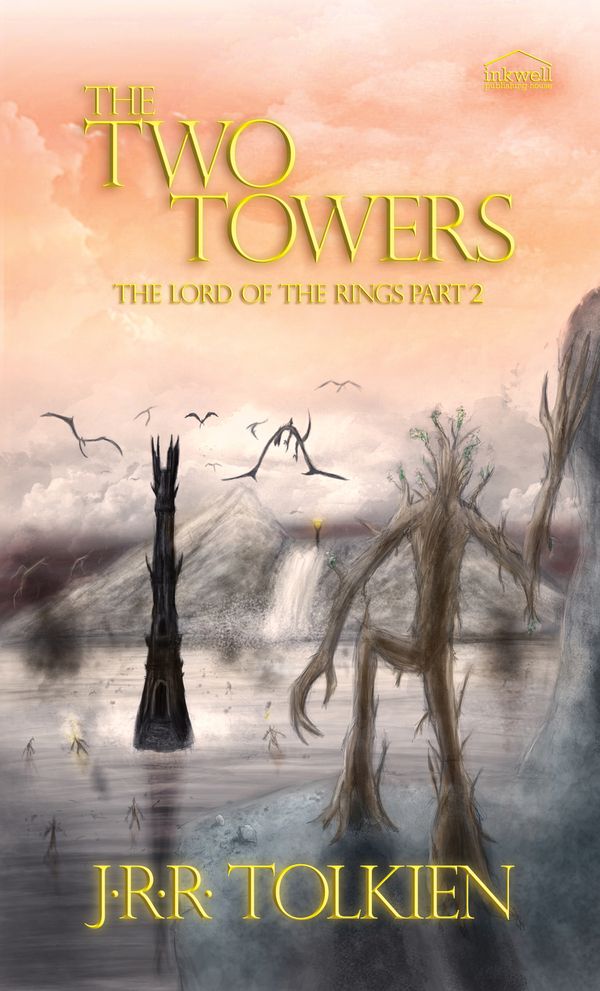
Pippin looked behind. The number of the Ents had grown — or what was happening? Where the dim bare slopes that they had crossed should lie, he thought he saw groves of trees. But they were moving! Could it be that the trees of Fangorn were awake, and the forest was rising, marching over the hills to war? He rubbed his eyes wondering if sleep and shadow had deceived him; but the great grey shapes moved steadily onward. There was a noise like wind in many branches. The Ents were drawing near the crest of the ridge now, and all song had ceased. Night fell, and there was silence: nothing was to be heard save a faint quiver of the earth beneath the feet of the Ents, and a rustle, the shade of a whisper as of many drifting leaves. At last they stood upon the summit, and looked down into a dark pit: the great cleft at the end of the mountains: Nan Curunír, the Valley of Saruman.
‘Night lies over Isengard,’ said Treebeard.
p.609
‘That is just as well,’ said Legolas. ‘But nonetheless it has suffered harm. There is something happening inside, or going to happen. Do you not feel the tenseness? It takes my breath.’
‘I feel the air is stuffy,’ said the Dwarf. ‘This wood is lighter than Mirkwood, but it is musty and shabby.’
‘It is old, very old,’ said the Elf. ‘So old that almost I feel young again, as I have not felt since I journeyed with you children. It is old and full of memory. I could have been happy here, if I had come in days of peace.’
‘I dare say you could,’ snorted Gimli. ‘You are a Wood-elf, anyway, though Elves of any kind are strange folk. Yet you comfort me. Where you go, I will go. But keep your bow ready to hand, and I will keep my axe loose in my belt. Not for use on trees,’ he added hastily, looking up at the tree under which they stood. ‘I do not wish to meet that old man at unawares without an argument ready to hand, that is all. Let us go!’
p.610
Aragorn looked and beheld a bent figure moving slowly. It was not far away. It looked like an old beggar-man, walking wearily, leaning on a rough staff. His head was bowed, and he did not look towards them. In other lands they would have greeted him with kind words; but now they stood silent, each feeling a strange expectancy: something was approaching that held a hidden power — or menace.
Gimli gazed with wide eyes for a while, as step by step the figure drew nearer. Then suddenly, unable to contain himself longer, he burst out: ‘Your bow, Legolas! Bend it! Get ready! It is Saruman. Do not let him speak, or put a spell upon us! Shoot first!’
Legolas took his bow and bent it, slowly and as if some other will resisted him. He held an arrow loosely in his hand but did not fit it to the string. Aragorn stood silent, his face was watchful and intent.
‘Why are you waiting? What is the matter with you?’ said Gimli in a hissing whisper.
‘Legolas is right,’ said Aragorn quietly. ‘We may not shoot an old man so, at unawares and unchallenged, whatever fear or doubt be on us. Watch and wait!’
At that moment the old man quickened his pace and came with surprising speed to the foot of the rock-wall. Then suddenly he looked up, while they stood motionless looking down. There was no sound.
They could not see his face: he was hooded, and above the hood he wore a wide-brimmed hat, so that all his features were overshadowed, except for the end of his nose and his grey beard. Yet it seemed to Aragorn that he caught the gleam of eyes keen and bright from within the shadow of the hooded brows.
At last the old man broke the silence. ‘Well met indeed, my friends,’ he said in a soft voice. ‘I wish to speak to you. Will you come down, or shall I come up?’ Without waiting for an answer he began to climb.
‘Now!’ cried Gimli. ‘Stop him, Legolas!’
‘Did I not say that I wished to speak to you?’ said the old man. ‘Put away that bow, Master Elf!’
The bow and arrow fell from Legolas’ hands, and his arms hung loose at his sides.
‘And you, Master Dwarf, pray take your hand from your axehaft, till I am up! You will not need such arguments.’
Gimli started and then stood still as stone, staring, while the old man sprang up the rough steps as nimbly as a goat. All weariness seemed to have left him. As he stepped up on the shelf there was a gleam, too brief for certainty, a quick glint of white, as if some garment shrouded by the grey rags had been for an instant revealed. The intake of Gimli’s breath could be heard as a loud hiss in the silence.
p.612
‘As for what I wished to say, I have said it: What may you be doing, and what tale can you tell of yourselves? As for my name!’ He broke off, laughing long and softly. Aragorn felt a shudder run through him at the sound, a strange cold thrill; and yet it was not fear or terror that he felt: rather it was like the sudden bite of a keen air, or the slap of a cold rain that wakes an uneasy sleeper.
‘My name!’ said the old man again. ‘Have you not guessed it already? You have heard it before, I think. Yes, you have heard it before. But come now, what of your tale?’
The three companions stood silent and made no answer.
‘There are some who would begin to doubt whether your errand is fit to tell,’ said the old man. ‘Happily I know something of it. You are tracking the footsteps of two young hobbits, I believe. Yes, hobbits. Don’t stare, as if you had never heard the strange name before. You have, and so have I. Well, they climbed up here the day before yesterday; and they met someone that they did not expect. Does that comfort you? And now you would like to know where they were taken? Well, well, maybe I can give you some news about that. But why are we standing? Your errand, you see, is no longer as urgent as you thought. Let us sit down and be more at ease.’
The old man turned away and went towards a heap of fallen stones and rock at the foot of the cliff behind. Immediately, as if a spell had been removed, the others relaxed and stirred. Gimli’s hand went at once to his axe-haft. Aragorn drew his sword. Legolas picked up his bow.
The old man took no notice, but stooped and sat himself on a low flat stone. Then his grey cloak drew apart, and they saw, beyond doubt, that he was clothed beneath all in white.
‘Saruman!’ cried Gimli, springing towards him with axe in hand. ‘Speak! Tell us where you have hidden our friends! What have you done with them? Speak, or I will make a dint in your hat that even a wizard will find it hard to deal with!’
The old man was too quick for him. He sprang to his feet and leaped to the top of a large rock. There he stood, grown suddenly tall, towering above them. His hood and his grey rags were flung away. His white garments shone. He lifted up his staff, and Gimli’s axe leaped from his grasp and fell ringing on the ground. The sword of Aragorn, stiff in his motionless hand, blazed with a sudden fire. Legolas gave a great shout and shot an arrow high into the air: it vanished in a flash of flame.
‘Mithrandir!’ he cried. ‘Mithrandir!’
‘Well met, I say to you again, Legolas!’ said the old man.
They all gazed at him. His hair was white as snow in the sunshine; and gleaming white was his robe; the eyes under his deep brows were bright, piercing as the rays of the sun; power was in his hand. Between wonder, joy, and fear they stood and found no words to say.
At last Aragorn stirred. ‘Gandalf!’ he said. ‘Beyond all hope you return to us in our need! What veil was over my sight? Gandalf!’ Gimli said nothing, but sank to his knees, shading his eyes.
‘Gandalf,’ the old man repeated, as if recalling from old memory a long disused word. ‘Yes, that was the name. I was Gandalf.’
He stepped down from the rock, and picking up his grey cloak wrapped it about him: it seemed as if the sun had been shining, but now was hid in cloud again. ‘Yes, you may still call me Gandalf,’ he said, and the voice was the voice of their old friend and guide. ‘Get up, my good Gimli! No blame to you, and no harm done to me. Indeed my friends, none of you have any weapon that could hurt me. Be merry! We meet again. At the turn of the tide. The great storm is coming, but the tide has turned.’
He laid his hand on Gimli’s head, and the Dwarf looked up and laughed suddenly. ‘Gandalf!’ he said. ‘But you are all in white!’
‘Yes, I am white now,’ said Gandalf. ‘Indeed I am Saruman, one might almost say, Saruman as he should have been. But come now, tell me of yourselves! I have passed through fire and deep water, since we parted. I have forgotten much that I thought I knew, and learned again much that I had forgotten. I can see many things far off, but many things that are close at hand I can not see. Tell me of yourselves!’
p.614
‘No, I did not find them,’ said Gandalf. ‘There was a darkness over the valleys of the Emyn Muil, and I did not know of their captivity, until the eagle told me.’
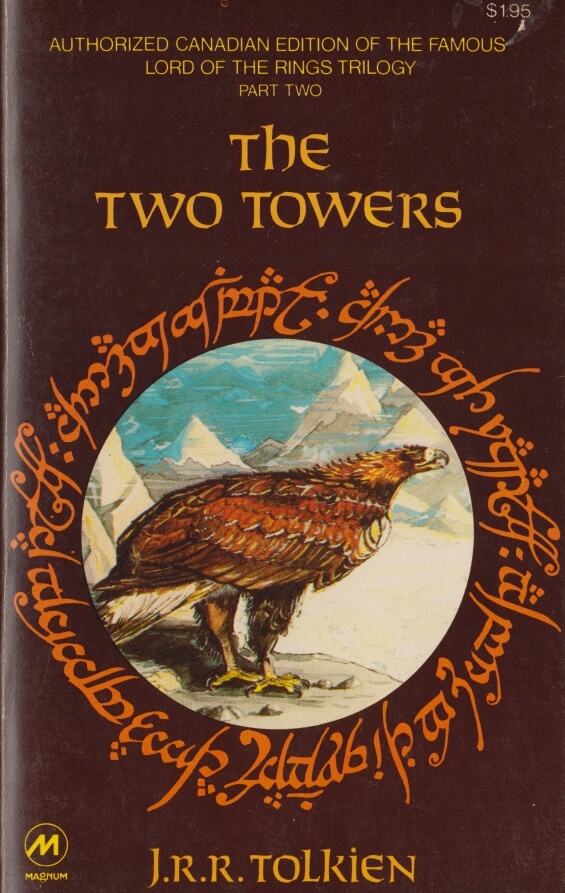
‘The eagle!’ said Legolas. ‘I have seen an eagle high and far off: the last time was four days ago, above the Emyn Muil.’
‘Yes,’ said Gandalf, ‘that was Gwaihir the Windlord, who rescued me from Orthanc. I sent him before me to watch the River and gather tidings. His sight is keen, but he cannot see all that passes under hill and tree. Some things he has seen, and others I have seen myself. The Ring now has passed beyond my help, or the help of any of the Company that set out from Rivendell. Very nearly it was revealed to the Enemy, but it escaped. I had some part in that: for I sat in a high place, and I strove with the Dark Tower; and the shadow passed. Then I was weary, very weary; and I walked long in dark thought.’
‘Then you know about Frodo!’ said Gimli. ‘How do things go with him?’
‘I cannot say. He was saved from a great peril, but many lie before him still. He resolved to go alone to Mordor, and he set out: that is all that I can say.’
‘Not alone,’ said Legolas. ‘We think that Sam went with him.’
‘Did he!’ said Gandalf, and there was a gleam in his eye and a smile on his face. ‘Did he indeed? It is news to me, yet it does not surprise me. Good! Very good! You lighten my heart. You must tell me more. Now sit by me and tell me the tale of your journey.’
The companions sat on the ground at his feet, and Aragorn took up the tale. For a long while Gandalf said nothing, and he asked no questions. His hands were spread upon his knees, and his eyes were closed. At last when Aragorn spoke of the death of Boromir and of his last journey upon the Great River, the old man sighed.
‘You have not said all that you know or guess, Aragorn my friend,’ he said quietly. ‘Poor Boromir! I could not see what happened to him. It was a sore trial for such a man: a warrior, and a lord of men. Galadriel told me that he was in peril. But he escaped in the end. I am glad. It was not in vail that the young hobbits came with us, if only for Boromir’s sake. But that is not the only part they have to play. They were brought to Fangorn, and their coming was like the falling of small stones that starts an avalanche in the mountains. Even as we talk here, I hear the first rumblings. Saruman had best not be caught away from home when the dam bursts!’
p.619
‘Treebeard is Fangorn, the guardian of the forest; he is the oldest of the Ents, the oldest living thing that still walks beneath the Sun upon this Middle-earth. I hope indeed, Legolas, that you may yet meet him. Merry and Pippin have been fortunate: they met him here, even where we sit. For he came here two days ago and bore them away to his dwelling far off by the roots of the mountains. He often comes here, especially when his mind is uneasy, and rumours of the world outside trouble him. I saw him four days ago striding among the trees, and I think he saw me, for he paused; but I did not speak, for I was heavy with thought, and weary after my struggle with the Eye of Mordor; and he did not speak either, nor call my name.’
p.620
Certainly the forest of Fangorn is perilous — not least to those that are too ready with their axes; and Fangorn himself, he is perilous too; yet he is wise and kindly nonetheless. But now his long slow wrath is brimming over, and all the forest is filled with it. The coming of the hobbits and the tidings that they brought have spilled it: it will soon be running like a flood; but its tide is turned against Saruman and the axes of Isengard. A thing is about to happen which has not happened since the Elder Days.
‘What will they do?’ asked Legolas in astonishment.
‘I do not know,’ said Gandalf. ‘I do not think they know themselves. I wonder.’ He fell silent, his head bowed in thought.
The others looked at him. A gleam of sun through fleeting clouds fell on his hands, which lay now upturned on his lap: they seemed to be filled with light as a cup is with water. At last he looked up and gazed straight at the sun.
p.620
He turned. ‘Come, Aragorn son of Arathorn!’ he said. ‘Do not regret your choice in the valley of the Emyn Muil, nor call it a vain pursuit. You chose amid doubts the path that seemed right: the choice was just, and it has been rewarded. For so we have met in time, who otherwise might have met too late. But the quest of your companions is over. Your next journey is marked by your given word. You must go to Edoras and seek out Théoden in his hall. For you are needed. The light of Andúril must now be uncovered in the battle for which it has so long waited. There is war in Rohan, and worse evil: it goes ill with Théoden.’
‘Then are we not to see the merry young hobbits again?’ said Legolas.
‘I did not say so,’ said Gandalf. ‘Who knows? Have patience. Go where you must go, and hope! To Edoras! I go thither also.’
‘It is a long way for a man to walk, young or old,’ said Aragorn. ‘I fear the battle will be over long ere I come there.’
‘We shall see, we shall see,’ said Gandalf. ‘Will you come now with me?’
‘Yes, we will set out together,’ said Aragorn. ‘But I do not doubt that you will come there before me, if you wish.’ He rose and looked long at Gandalf. The others gazed at them in silence as they stood there facing one another. The grey figure of the Man, Aragorn son of Arathorn, was tall, and stern as stone, his hand upon the hilt of his sword; he looked as if some king out of the mists of the sea had stepped upon the shores of lesser men. Before him stooped the old figure, white, shining now as if with some light kindled within, bent, laden with years, but holding a power beyond the strength of kings.
‘Do I not say truly, Gandalf,’ said Aragorn at last, ‘that you could go whithersoever you wished quicker than I? And this I also say: you are our captain and our banner. The Dark Lord has Nine. But we have One, mightier than they: the White Rider. He has passed through the fire and the abyss, and they shall fear him. We will go where he leads.’
p.622
‘Then tell us what you will, and time allows!’ said Gimli. ‘Come, Gandalf, tell us how you fared with the Balrog!’
‘Name him now!’ said Gandalf, and for a moment it seemed that a cloud of pain passed over his face, and he sat silent, looking old as death. ‘Long time I fell,’ he said at last, slowly, as if thinking back with difficulty. ‘Long I fell, and he fell with me. His fire was about me. I was burned. Then we plunged into the deep water and all was dark. Cold it was as the tide of death: almost it froze my heart.’
‘Deep is the abyss that is spanned by Durin’s Bridge, and none has measured it,’ said Gimli.
‘Yet it has a bottom, beyond light and knowledge,’ said Gandalf. ‘Thither I came at last, to the uttermost foundations of stone. He was with me still. His fire was quenched, but now he was a thing of slime, stronger than a strangling snake.
‘We fought far under the living earth, where time is not counted. Ever he clutched me, and ever I hewed him, till at last he fled into dark tunnels. They were not made by Durin’s folk, Gimli son of Glóin. Far, far below the deepest delvings of the Dwarves, the world is gnawed by nameless things. Even Sauron knows them not. They are older than he. Now I have walked there, but I will bring no report to darken the light of day. In that despair my enemy was my only hope, and I pursued him, clutching at his heel. Thus he brought me back at last to the secret ways of Khazad-dûm: too well he knew them all. Ever up now we went, until we came to the Endless Stair.’
‘Long has that been lost,’ said Gimli. ‘Many have said that it was never made save in legend, but others say that it was destroyed.’
‘It was made, and it had not been destroyed,’ said Gandalf. ‘From the lowest dungeon to the highest peak it climbed, ascending in unbroken spiral in many thousand steps, until it issued at last in Durin’s Tower carved in the living rock of Zirakzigil, the pinnacle of the Silvertine.
‘There upon Celebdil was a lonely window in the snow, and before it lay a narrow space, a dizzy eyrie above the mists of the world. The sun shone fiercely there, but all below was wrapped in cloud. Out he sprang, and even as I came behind, he burst into new flame. There was none to see, or perhaps in after ages songs would still be sung of the Battle of the Peak.’ Suddenly Gandalf laughed. ‘But what would they say in song? Those that looked up from afar thought that the mountain was crowned with storm. Thunder they heard, and lightning, they said, smote upon Celebdil, and leaped back broken into tongues of fire. Is not that enough? A great smoke rose about us, vapour and steam. Ice fell like rain. I threw down my enemy, and he fell from the high place and broke the mountain-side where he smote it in his ruin. Then darkness took me, and I strayed out of thought and time, and I wandered far on roads that I will not tell.
‘Naked I was sent back — for a brief time, until my task is done. And naked I lay upon the mountain-top. The tower behind was crumbled into dust, and the window gone; the ruined stair was choked with burned and broken stone. I was alone, forgotten, without escape upon the hard horn of the world. There I lay staring upward, while the stars wheeled over, and each day was as long as a life-age of the earth. Faint to my ears came the gathered rumour of all lands: the springing and the dying, the song and the weeping, and the slow everlasting groan of over-burdened stone. And so at the last Gwaihir the Windlord found me again, and he took me up and bore me away.
‘“Ever am I fated to be your burden, friend at need,” I said.
‘“A burden you have been,” he answered, “but not so now. Light as a swan’s feather in my claw you are. The Sun shines though you. Indeed I do not think you need me any more: were I to let you fall, you would float upon the wind.”
‘“Do not let me fall!” I gasped, for I felt life in me again. “Bear me to Lothlórien!”
‘“That indeed is the command of the Lady Galadriel who sent me to look for you,” he answered.
‘Thus it was that I came to Caras Galadhon and found you but lately gone. I tarried there in the ageless time of that land where days bring healing not decay. Healing I found, and I was clothed in white. Counsel I gave and counsel took. Thence by strange road I came, and messages I bring to some of you. To Aragorn I was bidden to say this:
Where now are the Dúnedain, Elessar, Elessar?
Why do thy kinsfolk wander afar?
Near is the hour when the Lost should come forth,
And the Grey Company ride from the North
But dark is the path appointed for thee:
The Dead watch the road that leads to the Sea.
To Legolas she sent this word:
Legolas Greenleaf long under tree
In joy thou hast lived. Beware of the Sea!
If thou hearest the cry of the gull on the shore,
Thy heart shall then rest in the forest no more.’
Gandalf fell silent and shut his eyes.
‘Then she sent me no message?’ said Gimli and bent his head.
‘Dark are her words,’ said Legolas, ‘and little do they mean to those that receive them.’
‘That is no comfort,’ said Gimli.
‘What then?’ said Legolas. ‘Would you have her speak openly to you of your death?’
‘Yes, if she had naught else to say.’
‘What is that?’ said Gandalf, opening his eyes. ‘Yes, I think I can guess what her words may mean. Your pardon, Gimli! I was pondering the messages once again. But indeed she sent words to you, and neither dark nor sad.
‘“To Gimli son of Glóin,” she said, “give his Lady’s greeting. Lockbearer, wherever thou goest my thought goes with thee. But have a care to lay thine axe to the right tree!”’
‘In happy hour you have returned to us, Gandalf,’ cried the Dwarf, capering as he sang loudly in the strange dwarf-tongue. ‘Come, come!’ he shouted, swinging his axe. ‘Since Gandalf’s head is now sacred, let us find one that it is right to cleave!’

p.625
‘They have not returned,’ said Legolas. ‘It will be a weary walk!’
‘I shall not walk. Time presses,’ said Gandalf. Then lifting up his head he gave a long whistle. So clear and piercing was the note that the others stood amazed to hear such a sound come from those old bearded lips. Three times he whistled; and then faint and far off it seemed to them that they heard the whinny of a horse borne up from the plains upon the eastern wind. They waited wondering. Before long there came the sound of hoofs, at first hardly more than a tremor of the ground perceptible only to Aragorn as he lay upon the grass, then growing steadily louder and clearer to a quick beat.
‘There is more than one horse coming,’ said Aragorn.
‘Certainly,’ said Gandalf. ‘We are too great a burden for one.’
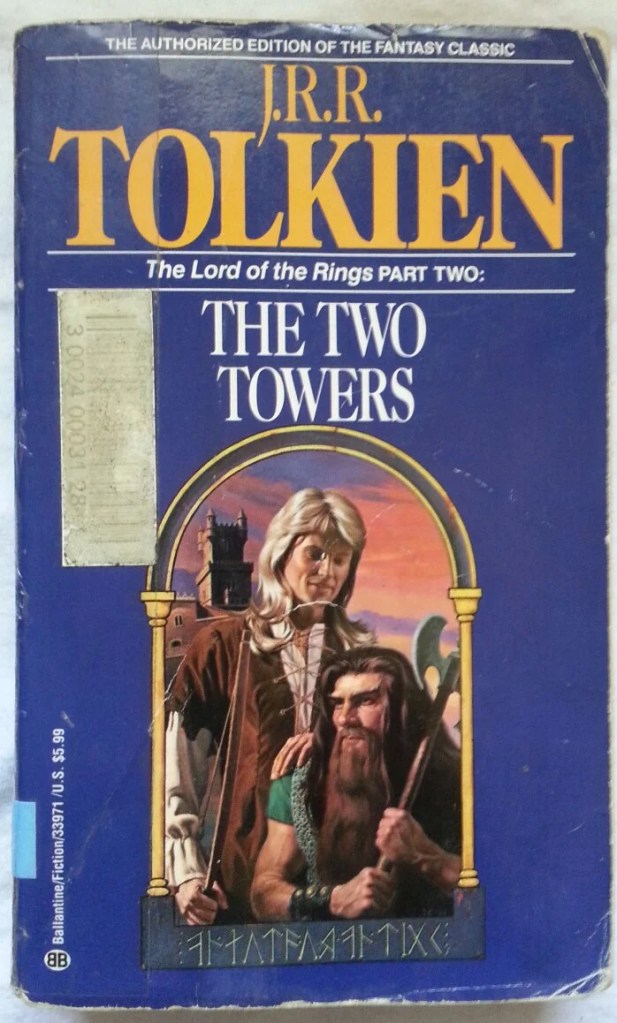
‘There are three,’ said Legolas, gazing out over the plain. ‘See how they run! There is Hasufel, and there is my friend Arod beside him! But there is another that strides ahead: a very great horse. I have not seen his like before.’
‘Nor will you again.’ said Gandalf. ‘That is Shadowfax. He is the chief of the Mearas, lords of horses, and not even Théoden, King of Rohan, has ever looked on a better. Does he not shine like silver, and run as smoothly as a swift stream? He has come for me: the horse of the White Rider. We are going to battle together.’
Even as the old wizard spoke, the great horse came striding up the slope towards them; his coat was glistening and his mane flowing in the wind of his speed. The two others followed, now far behind. As soon as Shadowfax saw Gandalf, he checked his pace and whinnied loudly; then trotting gently forward he stooped his proud head and nuzzled his great nostrils against the old man’s neck.
Gandalf caressed him. ‘It is a long way from Rivendell, my friend,’ he said; ‘but you are wise and swift and come at need. Far let us ride now together, and part not in this world again!’
p.634
‘Truly,’ said Aragorn. ‘And I would do as the master of the house bade me, were this only a woodman’s cot, if I bore now any sword but Andúril.’
‘Whatever its name may be,’ said Háma, ‘here you shall lay, if you would not fight alone against all the men in Edoras.’
‘Not alone!’ said Gimli, fingering the blade of his axe, and looking darkly up at the guard, as if he were a young tree that Gimli had a mind to fell. ‘Not alone!’
‘Come, come!’ said Gandalf. ‘We are all friends here. Or should be; for the laughter of Mordor will be our only reward, if we quarrel. My errand is pressing. Here at least is my sword, goodman Háma. Keep it well. Glamdring it is called, for the Elves made it long ago. Now let me pass. Come, Aragorn!’
Slowly Aragorn unbuckled his belt and himself set his sword upright against the wall. ‘Here I set it,’ he said; ‘but I command you not to touch it, nor to permit any other to lay hand on it. In this Elvish sheath dwells the Blade that was Broken and has been made again. Telchar first wrought it in the deeps of time. Death shall come to any man that draws Elendil’s sword save Elendil’s heir.’
The guard stepped back and looked with amazement on Aragorn. ‘It seems that you are come on the wings of song out of the forgotten days,’ he said. ‘It shall be, lord, as you command.’
‘Well,’ said Gimli, ‘if it has Andúril to keep it company, my axe may stay here, too, without shame’; and he laid it on the floor.
p.639
Slowly Théoden left his chair. A faint light grew in the hall again. The woman hastened to the king’s side, taking his arm, and with faltering steps the old man came down from the dais and paced softly through the hall. Wormtongue remained lying on the floor. They came to the doors and Gandalf knocked.
‘Open!’ he cried. ‘The Lord of the Mark comes forth!’
The doors rolled back and a keen air came whistling in. A wind was blowing on the hill.
‘Send your guards down to the stairs’ foot,’ said Gandalf. ‘And you, lady, leave him a while with me. I will care for him.’
‘Go, Éowyn sister-daughter!’ said the old king. ‘The time for fear is past.’
The woman turned and went slowly into the house. As she passed the doors she turned and looked back. Grave and thoughtful was her glance, as she looked on the king with cool pity in her eyes. Very fair was her face, and her long hair was like a river of gold. Slender and tall she was in her white robe girt with silver; but strong she seemed and stern as steel, a daughter of kings. Thus Aragorn for the first time in the full light of day beheld Éowyn, Lady of Rohan, and thought her fair, fair and cold, like a morning of pale spring that is not yet come to womanhood. And she now was suddenly aware of him: tall heir of kings, wise with many winters, greycloaked, hiding a power that yet she felt. For a moment still as stone she stood, then turning swiftly she was gone.
‘Now, lord,’ said Gandalf, ‘look out upon your land! Breathe the free air again!’
From the porch upon the top of the high terrace they could see beyond the stream the green fields of Rohan fading into distant grey. Curtains of wind-blown rain were slanting down. The sky above and to the west was still dark with thunder, and lightening far away flickered among the tops of hidden hills. But the wind had shifted to the north, and already the storm that had come out of the East was receding, rolling away southward to the sea. Suddenly through a rent in the clouds behind them a shaft of sun stabbed down. The falling showers gleamed like silver and far away the river glittered like a shimmering glass.
p.642
‘Will you not take the sword?’ said Gandalf.
Slowly Théoden stretched forth his hand. As his fingers took the hilt, it seemed to the watchers that firmness and strength returned to his thin arm. Suddenly he lifted the blade and swung it shimmering and whistling in the air. Then he gave a great cry. His voice rang clear as he chanted in the tongue of Rohan a call to arms.
Arise now, arise, Riders of Théoden!
Dire deeds awake, dark is it eastward.
Let horse be bridled, horn be sounded!
Forth Eorlingas!

p.643
‘This counsel seems good to me now,’ said Théoden. ‘Let all my folk get ready! But you my guests — truly you said, Gandalf, that the courtesy of my hall is lessened. You have ridden through the night, and the morning wears away. You have had neither sleep nor food. A guest-house shall be made ready: there you shall sleep, when you have eaten.’
‘Nay, lord,’ said Aragorn. ‘There is no rest yet for the weary. The men of Rohan must ride forth today, and we will ride with them, axe, sword, and bow. We did not bring them to rest against your wall, Lord of the mark. And I promised Éomer that my sword and his should be drawn together.’
‘Now indeed there is hope of victory!’ said Éomer.
‘Hope, yes,’ said Gandalf. ‘But Isengard is strong. And other perils draw even nearer. Do not delay, Théoden, when we are gone. Lead your people swiftly to the Hold of Dunharrow in the hills!’
‘Nay, Gandalf!’ said the king. ‘You do not know your own skill in healing. It shall not be so. I myself will go to war, to fall in the front of the battle, if it must be. Thus shall I sleep better.’
‘Then even the defeat of Rohan will be glorious in song,’ said Aragorn. The armed men that stood near clashed their weapons, crying: ‘The Lord of the Mark will ride! Forth Eorlingas!’
p.660
Gimli stood leaning against the breastwork upon the wall. Legolas sat above on the parapet, fingering his bow, and peering out into the gloom.
‘This is more to my liking,’ said the dwarf, stamping on the stones. ‘Ever my heart rises as we draw near the mountains. There is good rock here. This country has tough bones. I felt them in my feet as we came up from the dike. Give me a year and a hundred of my kin and I would make this a place that armies would break upon like water.’
‘I do not doubt it,’ said Legolas. ‘But you are a dwarf, and dwarves are strange folk. I do not like this place, and I shall like it no more by the light of day. But you comfort me, Gimli, and I am glad to have you standing nigh with your stout legs and your hard axe. I wish there were more of your kin among us. But even more would I give for a hundred good archers of Mirkwood. We shall need them. The Rohirrim have good bowmen after their fashion, but there are too few here, too few.’
‘It is dark for archery,’ said Gimli. ‘Indeed it is time for sleep. Sleep! I feel the need of it, as never I thought any dwarf could. Riding is tiring work. Yet my axe is restless in my hand. Give me a row of orc-necks and room to swing and all weariness will fall from me!’
A slow time passed. Far down in the valley scattered fires still burned. The hosts of Isengard were advancing in silence now. Their torches could be seen winding up the coomb in many lines.
Suddenly from the Dike yells and screams, and the fierce battle-cries of men broke out. Flaming brands appeared over the brink and clustered thickly at the breach. Then they scattered and vanished. Men came galloping back over the field and up the ramp to the gate of the Hornburg. The rearguard of the Westfolders had been driven in.
‘The enemy is at hand!’ they said. ‘We loosed every arrow that we had, and filled the Dike with Orcs. But it will not halt them long. Already they are scaling the bank at many points, thick as marching ants. But we have taught them not to carry torches!’
It was not past midnight. The sky was utterly dark, and the stillness of the heavy air foreboded storm. Suddenly the clouds were seared by a blinding flash. Branched lightning smote down upon the eastward hills. For a staring moment the watchers on the walls saw all the space between them and the Dike lit with white light: it was boiling and crawling with black shapes, some squat and broad, some tall and grim, with high helms and sable shields. Hundreds and hundreds more were pouring over the Dike and through the breach. The dark tide flowed up to the walls from cliff to cliff. Thunder rolled in the valley. Rain came lashing down.
Arrows thick as the rain came whistling over the battlements, and fell clinking and glancing on the stones. Some found a mark. The assault on Helm’s Deep had begun, but no sound or challenge was heard within; no answering arrows came.
The assailing hosts halted, foiled by the silent menace of rock and wall. Ever and gain the lightning tore aside the darkness. Then the Orcs screamed, waving spear and sword, and shooting a cloud of arrows at any that stood revealed upon the battlements; and the men of the Mark amazed looked out, as it seemed to them, upon a great field of dark corn, tossed by a tempest of war, and every ear glinted with barbed light.
Brazen trumpets sounded. The enemy surged forward, some against the Deeping Wall, others towards the causeway and the ramp that led up to the Hornburg-gates. There the hugest Orcs were mustered, and the wild men of the Dunland fells. A moment they hesitated and then on they came. The lightning flashed, and blazoned upon every helm and shield the ghastly hand of Isengard was seen. They reached the summit of the rock; they drove towards the gates.
Then at last an answer came: a storm of arrows met them, and a hail of stones. They wavered, broke, and fled back; and then charged again, broke and charged again; and each time, like the incoming sea, they halted at a higher point. Again trumpets rang, and a press of roaring men leaped forth. They held their great shields above them like a roof, while in their midst they bore two trunks of mighty trees. Behind them orc-archers crowded, sending a hail of darts against the bowmen on the walls. They gained the gates. The trees, swung by strong arms, smote the timbers with a rending boom. If any man fell, crushed by a stone hurtling from above, two others sprang to take his place. Again and again the great rams swung and crashed.
Éomer and Aragorn stood together on the Deeping Wall. They heard the roar of voices and the thudding of the rams; and then in a sudden flash of light they beheld the peril of the gates.
‘Come!’ said Aragorn. ‘This is the hour when we draw swords together!’
Running like fire, they sped along the wall, and up the steps, and passed into the outer court upon the Rock. As they ran they gathered a handful of stout swordsmen. There was a small postern-door that opened in an angle of the burg-wall on the west, where the cliff stretched out to meet it. On that side a narrow path ran round towards the great gate, between the wall and the sheer brink of the Rock. Together Éomer and Aragorn sprang through the door, their men close behind. The two swords flashed from the sheath as one.
‘Gúthwinë!’ cried Éomer. ‘Gúthwinë for the Mark!’
‘Andúril!’ cried Aragorn. ‘Andúril for the Dúnedain!’
Charging from the side, they hurled themselves upon the wild men. Andúril rose and fell, gleaming with white fire. A shout went up from wall and tower: ‘Andúril! Andúril goes to war. The Blade that was Broken shines again!’
Dismayed the rammers let fall the trees and turned to fight; but the wall of their shields was broken as by a lightning-stroke, and they were swept away, hewn down, or cast over the Rock into the stony stream below. The orc-archers shot wildly and then fled.
p.664
Two flung themselves to the ground at Éomer’s heels, tripped him, and in a moment they were on top of him. But a small dark figure that none had observed sprang out of the shadows and gave a hoarse shout: Baruk Khazâd! Khazâd ai-mênu! An axe swung and swept back. Two Orcs fell headless. The rest fled.
Éomer struggled to his feet, even as Aragorn ran back to his aid.
The postern was closed again, the iron door was barred and piled inside with stones. When all were safe within, Éomer turned: ‘I thank you, Gimli son of Glóin!’ he said. ‘I did not know that you were with us in the sortie. But oft the unbidden guest proves the best company. How came you here?’
‘I followed you to shake off sleep,’ said Gimli; ‘but I looked on the hillmen and they seemed over large for me, so I sat beside a stone to see your sword-play.’
‘I shall not find it easy to repay you,’ said Éomer.
‘There may be many a chance ere the night is over,’ laughed the Dwarf. ‘But I am content. Till now I have hewn naught but wood since I left Moria.’
‘Two!’ said Gimli, patting his axe. He had returned to his place on the wall.
‘Two?’ said Legolas. ‘I have done better, though now I must grope for spent arrows; all mine are gone. Yet I make my tale twenty at the least. But that is only a few leaves in a forest.’
p.665
Then a clamour arose in the Deep behind. Orcs had crept like rats through the culvert through which the stream flowed out. There they had gathered in the shadow of the cliffs, until the assault above was hottest and nearly all the men of the defence had rushed to the wall’s top. Then they sprang out. Already some had passed into the jaws of the Deep and were among the horses, fighting with the guards.
Down from the wall leapt Gimli with a fierce cry that echoed in the cliffs. ‘Khazâd! Khazâd!’ He soon had work enough.
‘Ai-oi!’ he shouted. ‘The Orcs are behind the wall. Ai-oi! Come, Legolas! There are enough for us both. Khazâd ai-mênu!’
Gamling the Old looked down from the Hornburg, hearing the great voice of the dwarf above all the tumult. ‘The Orcs are in the Deep!’ he cried. ‘Helm! Helm! Forth Helmingas!’ he shouted as he leaped down the stair from the Rock with many men of Westfold at his back.
Their onset was fierce and sudden, and the Orcs gave way before them. Ere long they were hemmed in in the narrows of the gorge, and all were slain or driven shrieking into the chasm of the Deep to fall before the guardians of the hidden caves.
‘Twenty-one!’ cried Gimli. He hewed a two-handed stroke and laid the last Orc before his feet. ‘Now my count passes Master Legolas again.’
‘We must stop this rat-hole,’ said Gamling. ‘Dwarves are said to be cunning folk with stone. Lend us your aid, master!’
p.666
He climbed up and found Legolas beside Aragorn and Éomer. The elf was whetting his long knife. There was for a while a lull in the assault, since the attempt to break in through the culvert had been foiled.
‘Twenty-one!’ said Gimli.
‘Good!’ said Legolas. ‘But my count is now two dozen. It has been knife-work up here.’
p.670
‘I looked out to see the dawn,’ said Aragorn.
‘What of the dawn?’ they jeered. ‘We are the Uruk-hai: we do not stop the fight for night or day, for fair weather or for storm. We come to kill, by sun or moon. What of the dawn?’
‘None knows what the new day shall bring him,’ said Aragorn. ‘Get you gone, ere it turn to your evil.’
‘Get down or we will shoot you from the wall,’ they cried. ‘This is no parley. You have nothing to say.’
‘I have still this to say,’ answered Aragorn. ‘No enemy has yet taken the Hornburg. Depart, or not one of you will be spared. Not one will be left alive to take back tidings to the North. You do not know your peril.’
So great a power and royalty was revealed in Aragorn, as he stood there alone above the ruined gates before the hosts of his enemies, that many of the wild men paused, and looked back over their shoulders to the valley, and some looked up doubtfully at the sky. But the Orcs laughed with loud voices; and a hail of darts and arrows whistled over the wall, as Aragorn leaped down.
p.672
So King Théoden rode from Helm’s Gate and clove his path to the great Dike. There the company halted. Light grew bright about them. Shafts of the sun flared above the eastern hills and glimmered on their spears. But they sat silent on their horses, and they gazed down upon the Deeping-coomb.
The land had changed. Where before the green dale had lain, its grassy slopes lapping the ever-mounting hills, there now a forest loomed. Great trees, bare and silent, stood, rank on rank, with tangled bough and hoary head; their twisted roots were buried in the long green grass. Darkness was under them. Between the Dike and the eaves of that nameless wood only two open furlongs lay. There now cowered the proud hosts of Saruman, in terror of the king and in terror of the trees. They streamed down from Helm’s Gate until all above the Dike was empty of them, but below it they were packed like swarming flies. Vainly they crawled and clambered about the walls of the coomb, seeking to escape. Upon the east too sheer and stony was the valley’s side; upon the left, from the west, their final doom approached.
There suddenly upon a ridge appeared a rider, clad in white, shining in the rising sun. Over the low hills the horns were sounding. Behind him, hastening down the long slopes, were a thousand men on foot; their swords were in their hands. Amid them strode a man tall and strong. His shield was red. As he came to the valley’s brink, he set to his lips a great black horn and blew a ringing blast.
‘Erkenbrand!’ the Riders shouted. ‘Erkenbrand!’
‘Behold the White Rider!’ cried Aragorn. ‘Gandalf is come again!’
‘Mithrandir, Mithrandir!’ said Legolas. ‘This is wizardry indeed! Come! I would look on this forest, ere the spell changes.’
The hosts of Isengard roared, swaying this way and that, turning from fear to fear. Again the horn sounded from the tower. Down through the breach of the Dike charged the king’s company. Down from the hills leaped Erkenbrand, lord of Westfold. Down leaped Shadowfax, like a deer that runs surefooted in the mountains. The White Rider was upon them, and the terror of his coming filled the enemy with madness. The wild men fell on their faces before him. The Orcs reeled and screamed and cast aside both sword and spear. Like a black smoke driven by a mounting wind they fled. Wailing they passed under the waiting shadow of the trees; and from that shadow none ever came again.
p.679
‘Strange are the ways of Men, Legolas! Here they have one of the marvels of the Northern World, and what do they say of it? Caves, they say! Caves! Holes to fly to in time of war, to store fodder in! My good Legolas, do you know that the caverns of Helm’s Deep are vast and beautiful? There would be an endless pilgrimage of Dwarves, merely to gaze at them, if such things were known to be. Aye indeed, they would pay pure gold for a brief glance!’
‘And I would give gold to be excused,’ said Legolas; ‘and double to be let out, if I strayed in!’
‘You have not seen, so I forgive your jest,’ said Gimli. ‘But you speak like a fool. Do you think those halls are fair, where your King dwells under the hill in Mirkwood, and Dwarves helped in their making long ago? They are but hovels compared with the caverns I have seen here: immeasurable halls, filled with an ever-lasting music of water that tinkles into pools, as fair as Kheled-zâram in the starlight.
‘And, Legolas, when the torches are kindled and men walk on the sandy floors under the echoing domes, ah! then, Legolas, gems and crystals and veins of precious ore glint in the polished walls; and the light glows through folded marbles, shell-like, translucent as the living hands of Queen Galadriel. There are columns of white and saffron and dawn-rose, Legolas, fluted and twisted into dreamlike forms; they spring up from many-coloured floors to meet the glistening pendants of the roof: wings, ropes, curtains fine as frozen clouds; spears, banners, pinnacles of suspended palaces! Still lakes mirror them: a glimmering world looks up from dark pools covered with clear glass; cities, such as the mind of Durin could scarce have imagined in his sleep, stretch on through avenues and pillared courts, on into the dark recesses where no light can come. And plink! a silver drop falls, and the round wrinkles in the glass make all the towers bend and waver like weeds and corals in a grotto of the sea. Then evening comes: they fade and twinkle out; the torches pass on into another chamber and another dream. There is chamber after chamber, Legolas; hall opening out of hall, dome after dome, stair beyond stair; and still the winding paths lead on into the mountains’ heart. Caves! The Caverns of Helm’s Deep! Happy was the chance that drove me there! It makes me wep to leave them.’
‘Then I will wish you this fortune for your comfort, Gimli,’ said the Elf, ‘that you may come safe from war and return to see them again. But do not tell all your kindred! There seems little left for them to do, from your account. Maybe the men of this land are wise to say little: one family of busy dwarves with hammer and chisel might mar more than they made.’
‘No, you do not understand,’ said Gimli. ‘No dwarf could be unmoved by such loveliness. None of Durin’s race would mine those caves for stones or ore, not if diamonds and gold could be got there. Do you cut down groves of blossoming trees in the springtime for firewood? We would tend these glades of flowering stone, not quarry them. With cautious skill, tap by tap — a small chip of rock and no more, perhaps, in a whole anxious day — so we would work, and as the years went by, we should open up new ways, and display far chambers that are still dark, glimpsed only as a void beyond fissures in the rock. And lights, Legolas! We should make lights, such lamps as once shone in Khazad-dûm; and when we wished we would drive away the night that has lain there since the hills were made; and when we desired rest, we would let the night return.’
‘You move me, Gimli,’ said Legolas. ‘I have never heard you speak like this before. Almost you make me regret that I have not seen these caves. Come! Let us make this bargain — if we both return safe out of the perils that await us, we will journey for a while together. You shall visit Fangorn with me, and then I will come with you to see Helm’s Deep.’
‘That would not be the way of return that I should choose,’ said Gimli. ‘But I will endure Fangorn, if I have your promise to come back to the caves and share their wonder with me.’
p.689
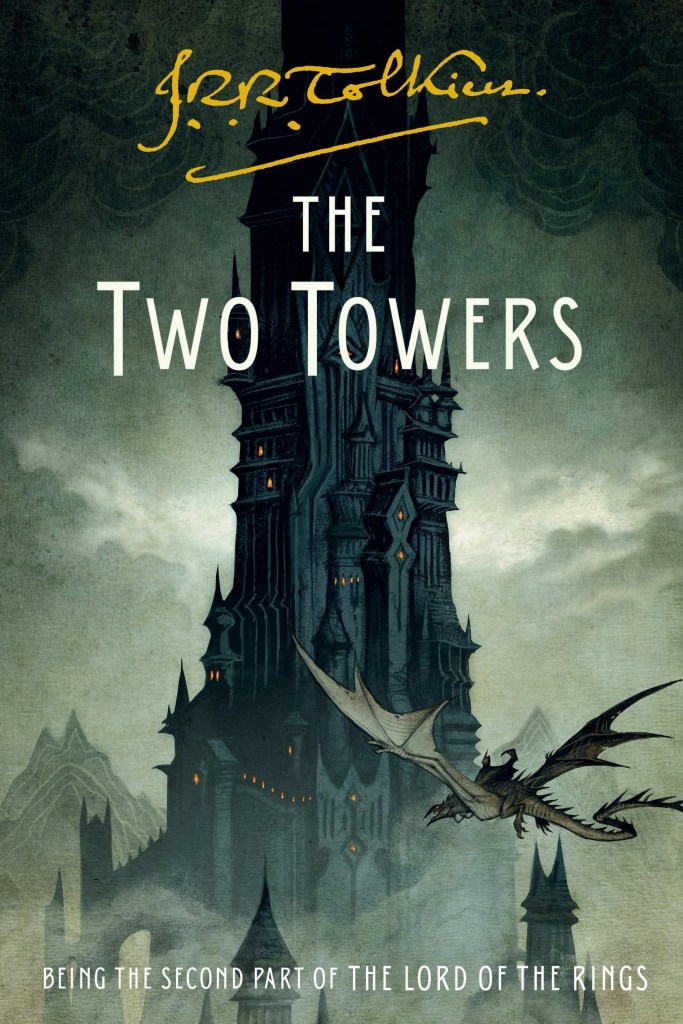
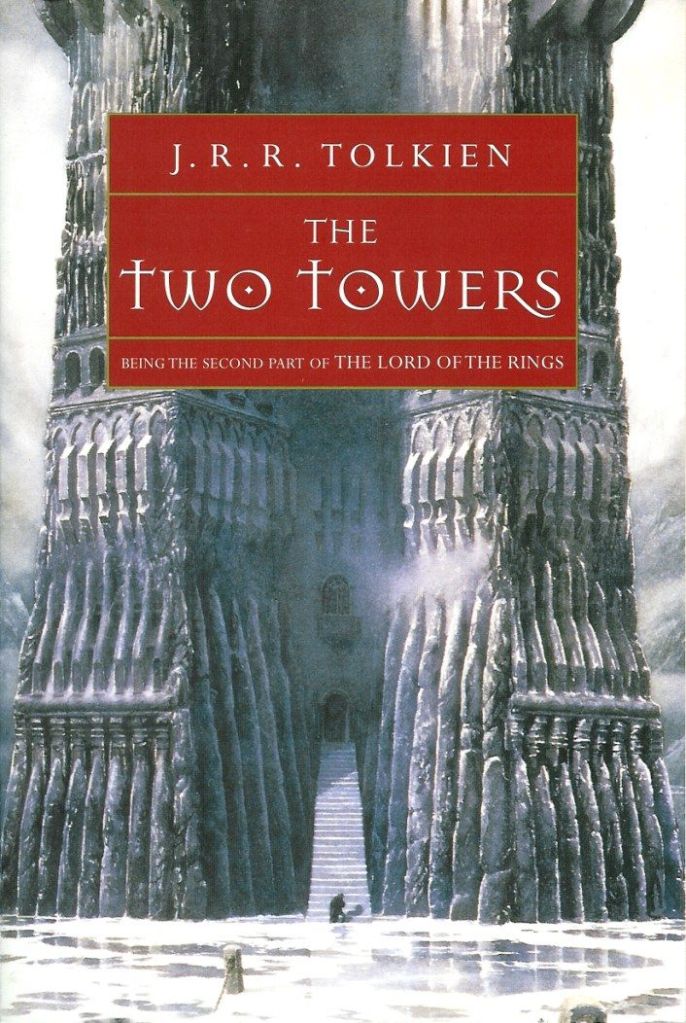
A strong place and wonderful was Isengard, and long it had been beautiful; and there great lords had dwelt, the wardens of Gondor upon the West, and wise men that watched the stars. But Saruman had slowly shaped it to his shifting purposes, and made it better, as he thought, being deceived — for all those arts and subtle devices, for which he forsook his former wisdom, and which fondly he imagined were his own, came but from Mordor; so that what he made was naught, only a little copy, a child’s model or a slave’s flattery, of that vast fortress, armoury, prison, furnace of great power, Barad-dûr, the Dark Tower, which suuffered no rival, and laughed at flattery, biding its time, secure in its pride and its immeasurable strength.
This was the stronghold of Saruman, as fame reported it; for within living memory the men of Rohan had not passed its gates, save perhaps a few, such as Wormtongue, who came in secret and told no man what they saw.
p.690
The king and all his company sat silent on their horses, marvelling, perceiving that the power of Saruman was overthrown; but how they could not guess. And now they turned their eyes towards the archway and the ruined gates. There they saw close beside them a great rubble-heap; and suddenly they were aware of two small figures lying on it at their ease, grey-clad, hardly to be seen among the stones. There were bottles and bowls and patters laid beside them, as if they had just eaten well, and now rested from their labour. One seemed asleep; the other, with crossed legs and arms behind his head, leaned back against a broken rock and sent from his mouth long wisps and little rings of thin blue smoke.
p.694
‘I will come with you, said Théoden. ‘Farewell, my hobbits! May we meet again in my house! There you shall sit beside me and tell me all that your hearts desire: the deeds of your grandsires, as far as you can reckon them; and we will speak also of Tobold the Old and his herb-lore. Farewell!’
The hobbits bowed low. ‘So that is the King of Rohan!’ said Pippin in an undertone. ‘A fine old fellow. Very polite.’
p.700
‘And here also is your brooch, Pippin,’ said Aragorn. ‘I have kept it safe, for it is a very precious thing.’
‘I know,’ said Pippin. ‘It was a wrench to let it go; but what else could I do?’
‘Nothing else,’ answered Aragorn. ‘One who cannot cast away a treasure at need is in fetters. You did rightly.’
p.705
‘When the Ents had reduced a large part of the southern walls to rubbish, and what was left of his people had bolted and deserted him, Saruman fled in a panic. He seems to have been at the gates when we arrived: I expect he came to watch his splendid army march out. When the Ents broke their way in, he left in a hurry. They did not spot him at first. But the night had opened out, and there was a great light of stars, quite enough for Ents to see by, and suddenly Quickbeam gave a cry “The tree-killer, the tree-killer!” Quickbeam is a gentle creature, but he hates Saruman all the more fiercely for that: his people suffered cruelly from orc-axes. He leapt down the path from the inner gate, and he can move like a wind when he is roused. There was a pale figure hurrying away in and out of the shadows of the pillars, and it had nearly reached the stairs to the tower-door. But it was a near thing. Quickbeam was so hot after him, that he was within a step or two of being caught and strangled when he slipped in through the door.
‘When Saruman was safe back in Orthanc, it was not long before he set some of his precious machinery to work. By that time where were many Ents inside Isengard: some had followed Quick-beam, and others had burst in from the north and east; they were roaming about and doing a great deal of damage. Suddenly up came fires and foul fumes: the vents and shafts all over the plain began to spout and belch. Several of the Ents got scorched and blistered. One of them, Beechbone I think he was called, a very tall handsome Ent, got caught in a spray of some liquid fire and burned like a torch: a horrible sight.
‘That sent them mad. I thought that they had been really roused before; but I was wrong. I saw what it was like at last. It was staggering. They roared and boomed and trumpeted, until stones began to crack and fall at the mere noise of them. Merry and I lay on the ground and stuffed our cloaks into our ears. Round and round the rock of Orthanc the Ents went striding and storming like a howling gale, breaking pillars, hurling avalanches of boulders down the shafts, tossing up huge slabs of stone into the air like leaves. The tower was in the middle of a spinning whirlwind. I saw iron posts and blocks of masonry go rocketing up hundreds of feet, and smash against the windows of Orthanc. But Treebeard kept his head. He had not had any burns, luckily. He did not want his folk to hurt themselves in their fury, and he did not want Saruman to escape out of some hole in the confusion. Many of the Ents were hurling themselves against the Orthanc-rock; but that defeated them. It is very smooth and hard. Some wizardry is in it, perhaps, older and stronger than Saruman’s. Anyway they could not get a grip on it, or make a crack in it; and they were bruising and wounding themselves against it.
p.727
‘I should dearly love to journey in Fangorn’s Wood. I scarcely passed beyond the eaves of it, and I did not wish to turn back.’
Treebeard’s eyes gleamed with pleasure. ‘I hope you may have your wish, ere the hills be much older,’ he said.
‘I will come, if I have the fortune,’ said Legolas. ‘I have made a bargain with my friend that, if all goes well, we will visit Fangorn together — by your leave.’
‘Any Elf that comes with you will be welcome,’ said Treebeard.
‘The friend I speak of is not an Elf,’ said Legolas; ‘I mean Gimli, Glóin son here.’ Gimli bowed low, and the axe slipped from his belt and clattered on the ground.
‘Hoom, hm! Ah now,’ said Treebeard, looking dark-eyed at him. ‘A dwarf and an axe-bearer! Hoom! I have good will to Elves; but you ask much. This is a strange friendship!’
‘Strange it may seem,’ said Legolas; ‘but while Gimli lives I shall not come to Fangorn alone. His axe is not for trees, but for orc-necks, O Fangorn, Master of Fangorn’s Wood. Forty-two he hewed in the battle.’
p.728
‘Yes, we must go, and go now,’ said Gandalf. ‘I fear that I must take your gatekeepers from you. But you will manage well enough without them.’
‘Maybe I shall,’ said Treebeard. ‘But I shall miss them. We have become friends in so short a while that I think I must be getting hasty — growing backwards towards youth, perhaps. But there, they are the first new thing under Sun or Moon that I have seen for many a long, long day. I shall not forget them. I have put their names into the Long List. Ents will remember it.
Ents the earthborn, old as mountains,
the wide-walkers, water drinking;
and hungry as hunters, the Hobbit children,
the laughing-folk, the little people,
they shall remain friends as long as leaves are renewed. Fare you well! But if you hear news up in your pleasant land, in the Shire, send me word! You know what I mean: word or sight of the Entwives. Come yourselves if you can!’
‘We will!’ said Merry and Pippin together, and they turned away hastily. Treebeard looked at them, and was silent for a while, shaking his head thoughtfully. Then he turned to Gandalf.
p.729
‘Leave it to the Ents!’ said Treebeard. ‘We shall search the valley from head to foot and peer under every pebble. Trees are coming back to live here, old trees, wild trees. The Watchwood we will call it. Not a squirrel will go here, but I shall know of it. Leave it to Ents! Until seven times the years in which he tormented us have passed, we shall not tire of watching him!’
p.738
With that Gandalf returned to the others, who were still standing by the Orthanc-stone in troubled thought. ‘Peril comes in the night when least expected,’ he said. ‘We have had a narrow escape!’
‘How is the hobbit, Pippin?’ asked Aragorn.
‘I think all will be well now,’ answered Gandalf. ‘He was not held long, and hobbits have an amazing power of recovery. The memory, or the horror of it, will probably fade quickly. Too quickly, perhaps. Will you, Aragorn, take the Orthanc-stone and guard it? It is a dangerous charge.’
‘Dangerous indeed, but not to all,’ said Aragorn. ‘There is one who may claim it by right. For this assuredly is the palantir of Orthanc from the treasury of Elendil, set here by the Kings of Gondor. Now my hour draws near. I will take it.’
Gandalf looked at Aragorn, and then, to the surprise of the others, he lifted the covered Stone, and bowed as he presented it.
‘Receive it, lord!’ he said: ‘in earnest of other things that shall be given back. But if I may counsel you in the use of your own, do not use it — yet! Be wary!’
‘When have I been hasty or unwary, who have waited and prepared for so many long years?’ said Aragorn.
‘Never yet. Do not then stumble at the end of the road,’ answered Gandalf. ‘But at the least keep this thing secret. You, and all others that stand here! The hobbit, Peregrin, above all should not know where it is bestowed. The evil fit may come on him again. For alas! he has handled it and looked in it, as should never have happened. He ought never to have touched it in Isengard, and there I should have been quicker. But my mind was bent on Saruman, and I did not at once guess the nature of the Stone. Then I was weary, and as I lay pondering it, sleep overcame me. Now I know!’
‘Yes, there can be no doubt,’ said Aragorn. ‘At last we know the link between Isengard and Mordor, and how it worked. Much is explained.’
‘Strange powers have our enemies, and strange weaknesses!’ said Théoden. ‘But it has long been said: oft evil will shall evil mar.’
‘That many times is seen,’ said Gandalf. ‘But at this time we have been strangely fortunate. Maybe, I have been saved by this hobbit from a grave blunder. I had considered whether or not to prove this Stone myself to find its uses. Had I done so, I should have been revealed to him myself. I am not ready for such a trial, if indeed I shall ever be so. But even if I found the power to withdraw myself, it would be disastrous for him to see me, yet — until the hour comes when secrecy will avail no longer.’
p.739
‘As you will,’ said Gandalf. ‘But make all the speed you may to the cover of the hills, to Helm’s Deep!’
At that moment a shadow fell over them. The bright moonlight seemed to be suddenly cut off. Several of the Riders cried out, and crouched, holding their arms above their heads, as if to ward off a blow from above: a blind fear and a deadly cold fell on them. Cowering they looked up. A vast winged shape passed over the moon like a black cloud. It wheeled and went north, flying at a speed greater than any wind of Middle-earth. The stars fainted before it. It was gone.
They stood up, rigid as stones. Gandalf was gazing up, his arms out and downwards, stiff, his hands clenched.
‘Nazgûl!’ he cried. ‘The messenger of Mordor. The storm is coming. The Nazgûl have crossed the River! Ride, ride! Wait not for the dawn! Let not the swift wait for the slow! Ride!’
He sprang away, calling Shadowfax as he ran. Aragorn followed him. Going to Pippin, Gandalf picked him up in his arms. ‘You shall come with me this time,’ he said. ‘Shadowfax shall show you his paces,’ Then he ran to the place where he had slept. Shadowfax stood there already. Slinging the small bag which was all his luggage across his shoulders, the wizard leapt upon the horse’s back. Aragorn lifted Pippin and set him in Gandalf’s arms, wrapped in cloak and blanket.
‘Farewell! Follow fast!’ cried Gandalf. ‘Away, Shadowfax!’
The great horse tossed his head. His flowing tail flicked in the moonlight. Then he leapt forward, spurning the earth, and was gone like the north wind from the mountains.
p.741
Pippin was recovering. He was warm, but the wind in his face was keen and refreshing. He was with Gandalf. The horror of the Stone and of the hideous shadow over the moon was fading, things left behind in the mists of the mountains or in a passing dream. He drew a deep breath.
‘I did not know you rode bare-back, Gandalf,’ he said. ‘You haven’t a saddle or a bridle!’
‘I do not ride elf-fashion, except on Shadowfax,’ said Gandalf. ‘But Shadowfax will have no harness. You do not ride Shadowfax: he is willing to carry you — or not. If he is willing, that is enough. It is then his business to see that you remain on his back, unless you jump off into the air.’
‘How fast is he going?’ asked Pippin. ‘Fast by the wind, but very smooth. And how light his footfalls are!’
‘He is running now as fast as the swiftest horse could gallop,’ answered Gandalf; ‘but that is not fast for him. The land is rising a little here, and is more broken than it was beyond the river. But see how the White Mountains are drawing near under the stars! Yonder are the Thrihyrne peaks like black spears. It will not be long before we reach the branching roads and come to the Deeping-coomb, where the battle was fought two nights ago.’
Pippin was silent again for a while. He heard Gandalf singing softly to himself, murmuring brief snatches of rhyme in many tongues, as the miles ran under them. At last the wizard passed into a song of which the hobbit caught the words: a few lines came clear to his ears through the rushing of the wind:
Tall ships and tall kings
Three times three,
What brought they from the foundered land
Over the flowing sea?
Seven stars and seven stones
And one white tree.
‘What are you saying, Gandalf?’ asked Pippin.
‘I was just running over some of the Rhymes of Lore in my mind,’ answered the wizard. ‘Hobbits, I suppose, have forgotten them, even those that they ever knew.’
‘No, not all,’ said Pippin. ‘And we have many of our own, which wouldn’t interest you, perhaps. But I have never heard this one. What is it about — the seven stars and seven stones?’
‘About the palantíri of the Kings of Old,’ said Gandalf.
‘And what are they?’
‘The name meant that which looks far away. The Orthanc-stone was one.’
‘Then it was not made, not made’ — Pippin hesitated — ‘by the Enemy?’
‘N0,’ said Gandalf. ‘Nor by Saruman. It is beyond his art, and beyond Sauron’s too. The palantíri came from beyond Westernesse, from Eldamar. The Noldor made them. Fëanor himself, maybe, wrought them, in days so long ago that the time cannot be measured in years. But there is nothing that Sauron cannot turn to evil uses. Alas for Saruman! It was his downfall, as I now perceive. Perilous to us all are the devices of an art deeper than we possess ourselves. Yet he must bear the blame. Fool! to keep it secret, for his own profit. No word did he speak of it to any of the Council. We had not yet given thought to the fate of the palantíri of Gondor in its ruinous wars. By Men they were almost forgotten. Even in Gondor they were a secret known only to a few; in Arnor they were remembered only in a rhyme of lore among the Dúnedain.’
‘What did the Men of old use them for?’ asked Pippin, delighted and astonished at getting answers to so many questions, and wondering how long it would last.
‘To see far off, and to converse in thought with one another,’ said Gandalf. ‘In that way they long guarded and united the realm of Gondor. They set up Stones at Minas Anor, and at Minas Ithil, and at Orthanc in the ring of Isengard. The chief and master of these was under the Dome of Stars at Osgiliath before its ruin. The three others were far away in the North. In the house of Elrond it is told that they were at Annúminas, and Amon Sûl, and Elendil’s Stone was one the Tower Hills that look towards Mithlond in the Gulf of Lune where they grey ships lie.
‘Each palatír replied to each, but all those in Gondor were ever open to the view of Osgiliath. Now it appears that, as the rock of Orthanc has withstood the storms of time, so there the palantír of that tower has remained. But alone it could do nothing but see small images of things far off and days remote. Very useful, no doubt, that was to Saruman; yet it seems that he was not content. Further and further abroad he gazed, until he cast his gaze upon Barad-dûr. Then he was caught!
‘Who knows where the lost stones of Arnor and Gondor now lie, buried, or drowned deep? But one at least Sauron must have obtained and mastered to his purposes. I guess that it was the Ithil-stone, for he took Minas Ithil long ago and turned it into an evil place: Minas Morgul, it has become.
p.759
But Sam did not answer: he was staring back up the cliff. ‘Ninnyhammers!’ he said. ‘Noodles! My beautiful rope! There it is tied to a stump, and we’re at the bottom. Just as nice a little stair for that slinking Gollum as we could leave. Better put up a signpost to say which way we’ve gone! I thought it seemed a bit too easy.’
‘If you can think of any way we could have both used the rope and yet brought it down with us, then you can pass on to me ninnyhammer, or any other name your gaffer gave you,’ said Frodo. ‘Climb up and untie it and let yourself down, if you want to!’
Sam scratched his head. ‘No, I can’t think how, begging your pardon,’ he said. ‘But I don’t like leaving it, and that’s a fact.’ He stroked the rope’s end and shook it gently. ‘It goes hard parting with anything I brought out of the Elf-country. Made by Galadriel herself, too, maybe. Galadriel,’ he murmured, nodding his head mournfully. He looked up and gave one last pull to the rope as if in farewell.
To the complete surprise of both the hobbits it came loose. Sam fell over, and the long grey coils slithered silently down on top of him. Frodo laughed. ‘Who tied the rope?’ he said. ‘A good thing it held as long as it did! To think that I trusted all my weight to your knot!’
Sam did not laugh. ‘I may not be much good at climbing, Mr. Frodo,’ he said in injured tones, ‘but I do know something about rope and about knots. It’s in the family, as you might say. Why, my grand-dad, and my uncle Andy after him, him that was the Gaffer’s eldest brother, he had a rope-walk over by Tighfield many a year. And I put as fast a hitch over the stump as anyone could have done, in the shire or out of it.’
‘Then the rope must have broken — frayed on the rock-edge, I expect,’ said Frodo.
‘I bet it didn’t!’ said Sam in an even more injured voice. He stooped and examined the ends. ‘Nor it hasn’t neither. Not a strand!’
‘Then I’m afraid it must have been the knot,’ said Frodo.
Sam shook his head and did not answer. He was passing the rope through his fingers thoughtfully. ‘Have it your own way, Mr. Frodo,’ he said at last, ‘but I think the rope came off itself — when I called.’ He coiled it up and stowed it lovingly in his pack.
p.793
Sam said nothing. The look on Frodo’s face was enough for him; he knew that words of his were useless. And after all he never had any real hope in the affair from the beginning; but being a cheerful hobbit he had not needed hope, as long as despair could be postponed. Now they were come to the bitter end. But he had stuck to his master all the way; that was what he had chiefly come for, and he would still stick to him. His master would not go to Mordor alone. Sam would go with him — and at any rate they would get rid of Gollum.
p.819
‘Farewell!’ said Frodo, bowing low. ‘Think what you will, I am a friend of all enemies of the One Enemy. We would go with you, if we halfling folk could hope to serve you, such doughty men and strong as you seem, and if my errand permitted it. May the light shine on your swords!’
‘The Halflings are courteous folk, whatever else they be,’ said Faramir. ‘Farewell!’
p.829
‘From Lórien,’ said Frodo. ‘In three such boats we rowed down Anduin to the Falls. They also were of elven-work.’
‘You passed through the Hidden Land,’ said Faramir, ‘but it seems that you little understood its power. If Men have dealings with the Mistress of Magic who dwells in the Golden Wood, then they may look for strange things to follow. For it is perilous for mortal man to walk out of the world of this Sun, and few of old came thence unchanged, ‘tis said.
‘Boromir, O Boromir!’ he cried. ‘What did she say to you, the Lady that dies not? What did she see? What woke in your heart then? Why went you ever to Laurelindórenan, and came not by your own road, upon the horses of Rohan riding home in the morning?’
p.832
We of my house are not of the line of Elendil, though the blood of Númenor is in us. For we reckon back our line to Mardil, the good steward, who ruled in the king’s stead when he went away to war. And that was King Eärnur, last of the line of Anárion, and childless, and he came never back. And the stewards have governed the city since that day, though it was many generations of Men ago.
‘And this I remember of Boromir as a boy, when we together learned the tale of our sires and the history of our city, that always displeased him that his father was not king. “How many hundreds of years needs it to make a steward a king, if the king returns not?” he asked. “Few years, maybe, in other places of less royalty,” my father answered. “In Gondor ten thousand years would not suffice.” Alas! poor Boromir. Does that not tell you something of him?’
‘It does,’ said Frodo. ‘Yet always he treated Aragorn with honour.’
‘I doubt it not,’ said Faramir. ‘If he were satisfied of Aragorn’s claim, as you say, he would greatly reverence him. But the pinch had not yet come. They had not yet reached Minas Tirith or become rivals in her wars.
‘But I stray. We in the house of Denethor know much ancient lore by long tradition, and there are moreover in our treasuries many things preserved: books and tablets writ on withered parchments, yea, and on stone, and on leaves of silver and of gold, in divers characters. Some none can now read; and for the rest, few ever unlocked them. I can read a little in them, for I have had teaching. It was these records that brought the Grey Pilgrim to us. I first saw him when I was a child and he has been twice or thrice since then.’
‘The Grey Pilgrim?’ said Frodo. ‘Had he a name?’
‘Mithrandir we called him in elf-fashion,’ said Faramir, ‘and he was content. Many are my names in many countries, he said. Mithrandir among the Elves, Tharkûn to the Dwarves; Olórin I was in my youth in the West that is forgotten, in the South Incánus, in the North Gandalf; to the East I go not.’
‘Gandalf!’ said Frodo. ‘I thought it was he. Gandalf the Grey, dearest of counsellors. Leader of our Company. He was lost in Moria.’
‘Mithrandir was lost!’ said Faramir. ‘An evil fate seems to have pursued your fellowship. It is hard indeed to believe that one of so great wisdom, and of power — for many wonderful thing he did among us — could perish, and so much lore be taken from the world. Are you sure of this, and that he did not just leave you and depart where he would?’
‘Alas! yes,’ said Frodo. ‘I saw him fall into the abyss.’
‘I see that there is some great tale of dread in this,’ said Faramir, ‘which perhaps you may tell me in the evening-time. This Mithrandir was, I now guess, more than a lore-master: a great mover of the deeds that are done in our time.’
p.834
‘What in truth this Thing is I cannot yet guess; but some heirloom of power and peril it must be. A fell weapon, perchance, devised by the Dark Lord. If it were a thing that gave advantage in battle, I can well believe that Boromir, the proud and fearless, often rash, ever anxious for the victory of Minas Tirith (and his own glory therein), might desire such a thing and be allured by it. Alas that ever he went on that errand! I should have been chosen by my father and the elders, but he put himself forward, as being the older and the hardier (both true), and he would not be stayed.
‘But fear no more! I would not take this thing, if it lay by the highway. Not were Minas Tirith falling in ruin and I alone could save her, so, using the weapon of the Dark Lord for her good and my glory. No, I do not wish for such triumphs, Frodo son of Drogo.’
‘Neither did the Council,’ said Frodo. ‘Nor do I. I would have nothing to do with such matters.’
‘For myself,’ said Faramir, ‘I would see the White Tree in flower again in the courts of the kings, and the Silver Crown return, and Minas Tirith in peace: Minas Anor as of old, full of light, high and fair, beautiful as a queen among other queens: not a mistress of many slaves, nay, not even a kind mistress of willing slaves. War must be, while we defend our lives against a destroyer who would devour all; but I do not love the bright sword for its sharpness, nor the arrow for its swiftness, nor the warrior for his glory. I love only that which they defend: the city of the Men of Númenor; and I would have her loved for her memory, her ancientry, her beauty, and her present wisdom. Not feared, save as men may fear the dignity of a man, old and wise.
‘So fear me not! I do not ask you to tell me more. I do not even ask you to tell me whether I now speak nearer the mark. But if you will trust me, it may be that I can advise you in your present quest, whatever that be — yes, and even aid you.’
Frodo made no answer. Almost he yielded to the desire for help and counsel, to tell this grave young man, whose words seemed so wise and fair, all that was in his mind. But something held him back. His heart was heavy with fear and sorrow: if he and Sam were indeed, as seemed likely, all that was now left of the Nine Walkers, then he was in sole command of the secret of their errand. Better mistrust undeserved than rash words. And the memory of Boromir, of the dreadful change that the lure of the Ring had worked in him, was very present to his mind, when he looked at Faramir and listened to his voice: unlike they were, and yet also much akin.
They walked on in silence for a while, passing like grey and green shadows under the old trees, their feet making no sound; above them many birds sang, and the sun glistened on the polished roof of dark leaves in the evergreen woods of Ithilien.
p.842
‘Maybe. But tell me now of your own fortunes,’ said Frodo, turning the matter aside once again. ‘For I would learn more of Minas Ithil and Osgiliath, and Minas Tirith the long-enduring. What hope have you for that city in your long war?’
‘What hope have we?’ said Faramir. ‘It is long since we had any hope. The sword of Elendil, if it returns indeed, may rekindle it, but I do not think that it will do more than put off the evil day, unless other help unlooked-for also comes, from Elves or Men. For the Enemy increases and we decrease. We are a failing people, a springless autumn.
‘The Men of Númenor were settled far and wide on the shores and seaward regions of the Great Lands, but for the most part they fell into evils and follies. Many became enamoured of the Darkness and the black arts; some were given over wholly to idleness and ease, and some fought among themselves, until they were conquered in their weakness by the wild men.
‘It is not said that evil arts were ever practised in Gondor, or that the Nameless One was ever mentioned in honour there; and the old wisdom and beauty brought out of the west remained long in the realm of the sons of Elendil the Fair, and they linger there still. Yet even so it was Gondor that brought about its own decay, falling by degrees into dotage, and thinking that the Enemy is asleep, who was only banished not destroyed.
‘Death was ever present because the Númenóreans still, as they had in their old kingdom, and so lost it, hungered after endless life unchanging. Kings made tombs more splendid than houses of the living, and counted old names in the rolls of their descent dearer than the names of sons. Childless lords sat in aged halls musing on heraldry; in secret chambers withered men compounded strong elixirs, or in high cold towers asked questions of the stars. And the last king of Anárion had no heir.
‘But the stewards were wiser and more fortunate. Wiser, for they recruited the strength of our people from the sturdy folk of the sea-coast, and from the hardy mountaineers of Ered Nimrais. And they made a truce with the proud peoples of the North, who often had assailed us, men of fierce valour, but our kin from afar off, unlike the wild Easterlings or the crude Haradrim.
‘So it came to pass in the days of Cirion the Twelfth Steward (and my father is the six and twentieth) that they rode to our aid and at the great Field of Celebrant they destroyed our enemies that had seized our northern provinces. These are the Rohirrim, as we name them, masters of horses, and we ceded to them the fields of Calenardhon that are since called Rohan; for that province thad long been sparsely peopled. And they became our allies, and have ever proved true to us, aiding us at need, and guarding our northern marches and the Gap of Rohan.
p.871
At that moment a rolling and rumbling noise was heard again, louder now and deeper. The ground seemed to quiver under their feet. ‘I think we are in for trouble anyhow,’ said Frodo. ‘I’m afraid our journey is drawing to an end.’
‘Maybe,’ said Sam; ‘but where there’s life there’s hope, as my gaffer used to say; and need of vittles, as he mostways used to add. You have a bite, Mr. Frodo, and then a bit of sleep.’
p.879
Even as these thoughts pierced him with dread and held him bound as with a spell, the Rider halted suddenly, right before the entrance of the bridge, and behind him all the host stood still. There was a pause, a dead silence. Maybe it was the Ring that called to the Wraith-lord, and for a moment he was troubled, sensing some other power within his valley. This way and that turned the dark head, helmed and crowned with fear, sweeping the shadows with its unseen eyes. Frodo waited, like a bird at the approach of a snake, unable to move. And as he waited, he felt, more urgent than ever before, the command that he should put on the Ring. But great as the pressure was, he felt no inclination now to yield to it. He knew that the Ring would only betray him, and that he had not, even if he put it on, the power to face the Morgul-king — not yet. There was no longer any answer to that command in his own will, dismayed by terror though it was, and he felt only the beating upon him of a great power from outside. It took his hand, and as Frodo watched with his mind, not willing it but in suspense (as if he looked on some old story far away), it moved the hand inch by inch towards the chain upon his neck. Then his own will stirred; slowly it forced the hand and set it to find another thing, a thing lying hidden near his breast. Cold and hard it seemed as his grip closed on it: the phial of Galadriel, so long treasured, and almost forgotten till that hour. As he touched it, for a while all thought of the Ring banished from his mind. He sighed and bent his head.

p.885
‘I don’t like anything here at all,’ said Frodo, ‘step or stone, breath or bone. Earth, air and water all seem accursed. But so our path is laid.’
‘Yes, that’s so,’ said Sam. ‘And we shouldn’t be here at all, if we’d known more about it before we started. But I suppose it’s often that way. The brave things in the old tales and songs, Mr. Frodo: adventures, as I used to call them. I used to think that they were things the wonderful folk of the stories went out and looked for, because they wanted them, because they were exciting and life was a bit dull, a kind of a sport, as you might say. But that’s not the way of it with the tales that really mattered, or the ones that stay in the mind. Folk seem to have been just landed in them, usually — their paths were laid that way, as you put it. But I expect they had lots of chances, like us, of turning back, only they didn’t. And if they had, we shouldn’t know, because they’d have been forgotten. We hear about those as just went on — and not all to a good end, mind you; at least not to what folk inside a story and not outside it call a good end. You know, coming home, and finding things all right, though not quite the same — like old Mr. Bilbo. But those aren’t always the best tales to hear, though they may be the best tales to get landed in! I wonder what sort of a tale we’ve fallen into?’
‘I wonder,’ said Frodo. ‘But I don’t know. And that’s the way of a real tale. Take any one that you’re fond of. You may know, or guess, what kind of a tale it is, happy-ending, or sad-ending, but the people in it don’t know. And you don’t want them to.’
‘No, sir, of course not. Beren now, he never thought he was going to get that Silmaril from the Iron Crown in Thangorodrim, and yet he did, and that was a worse place and a blacker danger than ours. But that’s a long tale, of course, and goes on past the happiness and into grief and beyond it — and the Silmaril went on and came to Eärendil. And why, sir, I never thought of that before! We’ve got — you’ve got some of the light of it in that starglass that the lady gave you! Why, to think of it, we’re in the same tale still! It’s going on. Don’t the great tales never end?’
‘No, they never end as tales,’ said Frodo. ‘But the people in them come, and go when their part’s ended. Our part will end later — or sooner.’
‘And then we can have some rest and some sleep,’ said Sam. He laughed grimly. ‘And I mean just that, Mr. Frodo. I mean plain ordinary rest, and sleep, and waking up to a morning’s work in the garden. I’m afraid that’s all I’m hoping for all the time. All the big important plans are not for my sort. Still, I wonder if we shall ever be put into songs or tales. We’re in one, of course; but I mean: put into words, you know, told by the fireside, or read out of a great big book with red and black letters, years and years afterwards. And people will say: “Let’s hear about Frodo and the Ring!” And they’ll say: “Yes, that’s one of my favourite stories. Frodo was very brave, wasn’t he, dad?” “Yes, my boy, the famousest of the hobbits, and that’s saying a lot.”’
‘It’s saying a lot too much,’ said Frodo, and he laughed, a long clear laugh from his heart. Such a sound had not been heard in those places since Sauron came to Middle-earth. To sam suddenly it seemed as if all the stones were listening and the tall rocks leaning over them. But Frodo did not heed them; he laughed again. ‘Why, Sam,’ he said, ‘to hear you somehow makes me as merry as if the story was already written. But you’ve left out one of the chief characters: Samwise the stouthearted. “I want to hear more about Sam, dad. Why didn’t they put in more of his talk, dad? That’s what I like, it makes me laugh. And Frodo wouldn’t have got far without Sam, would he, dad?”’
‘Now, Mr. Frodo,’ said Sam, ‘you shouldn’t make fun. I was serious.’
‘So was I,’ said Frodo, ‘and so I am. We’re going on a bit too fast. You and I, Sam, are still stuck in the worst places of the story, and it is all too likely that some will say at this point: “Shut the book now, dad; we don’t want to read any more.”’
p.895
‘It’s a trap!’ said Sam, and he laid his hand upon the hilt of his sword; and as he did so, he thought of the darkness of the barrow whence it came. ‘I wish old Tom was near us now!’ he thought. Then, as he stood, darkness about him and a blackness of despair and anger in his heart, it seemed to him that he saw a light: a light in his mind, almost unbearably bright at first, as a sun-ray to the eyes of one long hidden in a windowless pit. Then the light became colour: green, gold, silver, white. Far off, as in a little picture drawn by elven-fingers, he saw the Lady Galadriel standing on the grass in Lórien, and gifts were in her hands. And you, Ring-bearer, he heard her say, remote but clear, for you I prepared this.
The bubbling hiss drew nearer, and there was a creaking as of some great jointed thing that moved with slow purpose in the dark. A reek came before it. ‘Master, master!’ cried Sam, and life and urgency came back into his voice. ‘The Lady’s gift! The star-glass! A light to you in dark places, she said it was to be. The star-glass!’
‘The star-glass?’ muttered Frodo, as one answering out of sleep, hardly comprehending. ‘Why yes! Why had I forgotten it? A light when all other lights go out! And now indeed light alone can help us.’
Slowly his hand went to his bosom, and slowly he held aloft the Phial of Galadriel. For a moment it glimmered, faint as a rising star struggling in heavy earthward mists, and then as its power waxed, and hope grew in Frodo’s mind, it began to burn, and kindled to a silver flame, a minute heart of dazzling light, as though Eärendil had himself come down from the high sunset paths with the last Silmaril upon his brow. The darkness receded from it, until it seemed to shine in the centre of a globe of airy crystal, and the hand that held it sparkled with white fire.
Frodo gazed in wonder at this marvellous gift that he had so long carried, not guessing its full worth and potency. Seldom had he remembered it on the road, until they came to Morgul Vale, and never had he used it for fear of its revealing light. Aiya Eärendil Elenion Ancalima! he cried, and knew not what he had spoken; for it seemed another voice spoke through his, clear, untroubled by the foul air of the pit.
p.900
There agelong she dwelt, an evil thing in spider-form, even such as once of old had lived in the Land of the Elves in the West that is now under the Sea, such as Beren fought in the Mountains of Terror in Doriath, and so came to Lúthien upon the green sward amid the hemlocks in the moonlight long ago. How Shelob came there, flying from ruin, no tale tells, for out of the Dark Years few tales have come. But still she was there, who was there before Sauron, and before the first stone of Barad-dûr; and she served none but herself, drinking the blood of Elves and Men, bloated and grown fat with endless brooding on her feasts, weaving webs of shadow; for all living things were her food, and her vomit darkness. Far and wide her lesser broods, bastards of the miserable mates, her own offspring, that she slew, spread from glen to glen, from the Ephel Dúath to the eastern hills, to Dol Guldur and the fastnesses of Mirkwood. But none could rival her, Shelob the Great, last child of Ungoliant to trouble the unhappy world.
Already, years before, Gollum had beheld her, Sméagol who pried into all dark holes, and in the past days he had bowed and worshipped her, and the darkness of her evil will walked through all the ways of his weariness beside him, cutting him off from light and from regret. And he had promised to bring her food. But her lust was not his lust. Little she knew of or cared for towers, or rings, or anything devised by mind or hand, who only desired death for all others, mind and body, and for herself a glut of life, alone, swollen till the mountains could no longer hold her up and the darkness could not contain her.
p.908
Even as Sam crouched himself, looking at her, seeing his death in her eyes, a thought came to him, as if some remote voice had spoken, and he fumbled in his breast with his left hand, and found what he sought: cold and hard and solid it seemed to his touch in a phantom world of horror, the Phial of Galadriel.
‘Galadriel!’ he said faintly, and then he heard voices far off but clear: the crying of the Elves as they walked under the stars in the beloved shadows of Shire, and the music of the Elves as it came through his sleep in the Hall of Fire in the house of Elrond.
Gilthoniel A Elbereth!
And then his tongue was loosed and his voice cried in a language which he did not know:
A Elbereth Gilthoniel
o menel palan-diriel,
le nallon sí di’nguruthos!
A tiro nin, Fanuilos!
And with that he staggered to his feet and was Samwise the hobbit, Hamfast’s son, again.
‘Now come, you filth!’ he cried. ‘You’ve hurt my master, you brute, and you’ll pay for it. We’re going on; but we’ll settle with you first. Come on, and taste it again!’
As if his indomitable spirit had set its potency in motion, the glass blazed suddenly like a white torch in his hand. It flamed like a star that leaping from the firmament sears the dark air with intolerable light. No such terror out of heaven had ever burned in Shelob’s face before. The beams of it entered into her wounded head and scored it with unbearable pain, and the dreadful infection of light spread from eye to eye. She fell back beating the air with her forelegs, her sight blasted by inner lightnings, her mind in agony. Then turning her maimed head away, she rolled aside and began to crawl, claw by claw, towards the opening in the dark cliff behind.
 Universe of Dahee