
p.10
He walked fairly fast, and doggedly, without looking much about him, like a man trying to shorten the way with some interesting train of thought. He was tall, but a little round-shouldered, about thirty-five to forty years of age, and dressed with that particular kind of shabbiness which marks a member of the intelligentsia on a holiday. He might easily have been mistaken for a doctor or a school master at first sight, though he had not the man-of-the-world air of the one or the indefinable breeziness of the other. In fact, he was a philologist, and fellow of a Cambridge college. His name was Ransom.
ㅤ
ㅤ
p.15
Devine indicated his massive and loud-voiced companion. “The Weston,” he added. “You know. The great physicist. Has Einstein on toast and drinks a pint of Schrödinger’s blood for breakfast. Weston, allow me to introduce my old schoolfellow, Ransom. Dr. Elwin Ransom. The Ransom, you know. The great philologist. Has Jespersen on toast and drinks a pint──”
“I know nothing about it,” said Weston, who was still holding the unfortunate Harry by the collar. “And if you expect me to say that I am pleased to see this person who has just broken into my garden, you will be disappointed. I don’t care two-pence what school he was at nor on what unscientific foolery he is at present wasting money that ought to go to research. I want to know what he’s doing here: and after that I want to see the last of him.”
ㅤ
ㅤ
p.20
While Devine was speaking something odd began to happen to Ransom. At first it merely seemed to him that Devine’s words were no longer making sense. He appeared to be saying that he was industrial all down both sides but could never get an experiment to fit him in London. Then he realised that Devine was not so much unintelligible as inaudible, which was not surprising, since he was now so far away─about a mile away, though perfectly clear like something seen through the wrong end of a telescope. From that bright distance where he sat in his tiny chair he was gazing at Ransom with a new expression on his face. The gaze became disconcerting. Ransom tried to move in his chair but found that he had lost all power over his own body. He felt quite comfortable, but it was as if his legs and arms had been bandaged to the chair and his head gripped in a vice; a beautifully padded, but quite immovable vice. He did not feel afraid, thought he knew that he ought to be afraid and soon would be. Then, very gradually, the room faded from his sight.
Ransom could never be sure whether what followed had any bearing on the events recorded in this book or whether it was merely an irresponsible dream. It seemed to him that he and Weston and Devine were all standing in a little garden surrounded by a wall. The garden was bright and sunlit, but over the top of the wall you could see nothing but darkness. They were trying to climb over the wall and Weston asked them to give him a hoist up. Ransom kept on telling him not to go over the wall because it was so dark on the other side, but Weston insisted, and all three of them set about doing so. Ransom was the last. He got astride on the top of the wall, sitting on his coat because of the broken bottles. The other two had already dropped down on the outside into the darkness, but before he followed them a door in the wall―which none of them had noticed―was opened from without the queerest people he had ever seen came into the garden bringing Weston and Devine back with them. They left them in the garden and retired into the darkness themselves, locking the door behind them. Ransom found it impossible to get down from the wall. He remained sitting there, not frightened but rather uncomfortable because his right leg, which was on the outside, felt so dark and his left leg so light. “My leg will drop off if it gets much darker,” he said. Then he looked down into the darkness and asked, “Who are you?” and the Queer People must still have been there for they all replied, “Hoo―Hoo―Hoo?” just like owls.
ㅤ

ㅤ
ㅤ
p.25
At that moment the sound of an opening door made him turn his head. An oblong of dazzling light appeared behind him and instantly vanished as the door closed again, having admitted the bulky form of a naked man whom Ransom recognised as Weston. No reproach, no demand for an explanation, rose to Ransom’s lips or even to his mind; not with that monstrous orb above them. The mere presence of a human being, with its offer of at least some companionship, broke down the tension in which his nerves had long been resisting a bottomless dismay. He found, when he spoke, that he was sobbing.
“Weston! Weston!” he gasped. “What is it? It’s not the moon, not that size. It can’t be, can it?”
“No,” replied Weston, “it’s the Earth.”
ㅤ
ㅤ
p.27
For a moment Weston seemed disposed to give no answer; then, as if on a second thought, he sat down on the bed beside Ransom and spoke as follows:
“I suppose it will save trouble if I deal with these questions at once, instead of leaving you to pester us with them every hour for the next month. As to how we do it—I suppose you mean how the space-ship works—there’s no good your asking that. Unless you were one of the four or five real physicists now living you couldn’t understand: and if there were any chance of your understanding you certainly wouldn’t be told. If it makes you happy to repeat words that don’t mean anything—which is, in fact, what unscientific people want when they ask for an explanation—you may say we work by exploiting the less observed properties of solar radiation. As to why we are here, we are on our way to Malacandra . . .”
“Do you mean a star called Malacandra?”
“Even you can hardly suppose we are going out of the solar system. Malacandra is much nearer then that: we shall make it in about twenty-eight days.”
“There isn’t a planet called Malacandra,” objected Ransom.
“I am giving it its real name, not the name invented by terrestrial astronomers,” said Weston.
“But surely this is nonsense,” said Ransom. “How the deuce did you find out its real name, as you call it?”
“From the inhabitants.”
It took Ransom some time to digest this statement. “Do you mean to tell me you claim to have been to this star before, or this planet, or whatever it is?”
“Yes.”
“You can’t really ask me to believe that,” said Ransom. “Damn it all, it’s not an everyday affair. Why has no one heard of it? Why has it not been in all the papers?”
“Because we are not perfect idiots,” said Weston gruffly.
After a few moments’ silence Ransom began again. “Which planet is it in our terminology?” he asked.
“Once and for all,” said Weston, “I am not going to tell you. If you know how to find out when we get there, you are welcome to do so: I don’t think we have much to fear from your scientific attainments. In the meantime, there is no reason for you to know.”
“And you say this place is inhabited?” said Ransom.
Weston gave him a peculiar look and then nodded. The uneasiness which this produced in Ransom rapidly merged in an anger which he had almost lost sight of amidst the conflicting emotions that beset him.
“And what has all this to do with me?” he broke out. “You have assaulted me, drugged me, and are apparently carrying me off as a prisoner in this infernal thing. What have I done to you? What do you say for yourself?”
“I might reply by asking you why you crept into my backyard like a thief. If you had minded your own business you would not be here. As it is, I admit that we have had to infringe your rights. My only defence is that small claims must give way to great. As far as we know, we are doing what has never been done in the history of man, perhaps never in the history of the universe. We have learned how to jump off the speck of matter on which our species began; infinity, and therefore perhaps eternity, is being put into the hands of the human race. You cannot be so small-minded as to think that the rights or the life of an individual or of a million individuals are of the slightest importance in comparison with this.”
“I happen to disagree,” said Ransom, “and I always have disagreed, even about vivisection. But you haven’t answered my question. What do you want me for? What good am I to you on this—on Malacandra.”
“That I don’t know,” said Weston. “It was no idea of ours. We are only obeying orders.”
“Whose?”
There was another pause. “Come,” said Weston at last, “there is really no use in continuing this cross-examination. You keep on asking me questions I can’t answer: in some cases because I don’t know the answers, in others because you wouldn’t understand them. It will make things very much pleasanter during the voyage if you can only resign your mind to your fate and stop bothering yourself and us. It would be easier if your philosophy of life were not so insufferably narrow and individualistic. I had thought no one could fail to be inspired by the role you are being asked to play: that even a worm, if it could understand, would rise to the sacrifice. I mean, of course, the sacrifice of time and liberty, and some little risk. Don’t misunderstand me.”
“Well,” said Ransom, “you hold all the cards, and I must make the best of it. I consider your philosophy of life raving lunacy. I suppose all that stuff about infinity and eternity means that you think you are justified in doing anything—absolutely anything—here and now, on the off chance that some creatures or other descended from man as we know him may crawl about a few centuries longer in some part of the universe.”
“Yes—anything whatever,” returned the scientist sternly, “and all educated opinion—for I do not call classics and history and such trash education—is entirely on my side. I am glad you raised the point, and I advise you to remember my answer.”
ㅤ
ㅤ
p.33
All this, as I have said, was sufficiently disquieting. The odd thing was that it did not very greatly disquiet him. It is hard for a man to brood on the future when he is feeling so extremely well as Ransom now felt. There was an endless night on one side of the ship and an endless day on the other: each was marvellous and he moved from the one to the other at his will, delighted. In the nights, which he could create by turning the handle of a door, he lay for hours in contemplation of the skylight. The Earth’s disk was nowhere to be seen; the stars, thick as daisies on an uncut lawn, reigned perpetually with no cloud, no moon, no sunrise to dispute their sway. There were planets of unbelievable majesty, and constellations undreamed of: there were celestial sapphires, rubies, emeralds and pinpricks of burning gold; far out on the left of the picture hung a comet, tiny and remote: and between all and behind all, far more emphatic and palpable than it showed on Earth, the undimensioned, enigmatic blackness. The lights trembled: they seemed to grow brighter as he looked. Stretched naked on his bed, a second Danaë, he found it night by night more difficult to disbelieve in old astrology: almost he felt, wholly he imagined, “sweet influence” pouring or even stabbing into his surrendered body. All was silence but for the irregular tinkling noises. He knew now that these were made by meteorites, small drifting particles of the world-stuff that smote continually on their hollow drum of steel; and he guessed that at any moment they might meet something large enough to make meteorites of ship and all. But he could not fear. He now felt that Weston had justly called him little-minded in the moment of his first panic. The adventure was too high, its circumstance too solemn, for any emotion save a severe delight. But the days—that is, the hours’ spent in the sunward hemisphere of their microcosm—were the best of all. Often he rose after only a few hours’ sleep to return, drawn by an irresistible attraction, to the regions of light; he could not cease to wonder at the noon which always awaited you however early you went to seek it. There, totally immersed in a bath of pure ethereal colour and of unrelenting though unwounding brightness, stretched his full length and with eyes half closed in the strange chariot that bore them, faintly quivering, through depth after depth of tranquility far above the reach of night, he felt his body and mind daily rubbed and scoured and filled with new vitality. Weston, in one of his brief, reluctant answers, admitted a scientific basis for these sensations: they were receiving, he said, many rays that never penetrated the terrestrial atmosphere.
But Ransom, as time wore on, became aware of another and more spiritual cause for his progressive lightening and exultation of heart. A nightmare, long engendered in the modern mind by the mythology that follows in the wake of science, was falling off him. He had read of ‘Space’:at the back of his thinking for years had lurked the dismal fancy of the black, cold vacuity, the utter deadness, which was supposed to separate the worlds. He had not known how much it affected him till now—now that the very name ‘Space’ seemed a blasphemous libel for this empyrean ocean of radiance in which they swam. He could not call it “dead’; he felt life pouring into him from it every moment. How indeed should it be otherwise, since out of this ocean the worlds and all their life had come? He had thought it barren: he saw now that it was the womb of worlds, whose blazing and innumerable offspring looked down nightly even upon the earth with so many eyes—and here, with how many more! No: space was the wrong name. Older thinkers had been wiser when they named it simply the heavens—the heavens which declared the glory—the
“happy climes that ly
Where day never shuts his eye
Up in the broad fields of the sky.”
He quoted Milton’s words to himself lovingly, at this time and often.
ㅤ
ㅤ

ㅤ
p.41
Suddenly the lights of the Universe seemed to be turned down. As if some demon had rubbed the heaven’t face with a dirty sponge, the splendour in which they had lived for so long blenched to a pallid, cheerless and pitiable grey. It was impossible from where they sat to open the shutters or roll back the heavy blind. What had been a chariot gliding in the fields of heaven became a dark steel box dimly lighted by a slit of window, and falling. They were falling out of the heaven, into a world. Nothing in all his adventures bit so deeply into Ransom’s mind as this. He wondered how he could ever have thought of planets, even of the Earth, as islands of life and reality floating in a deadly void. Now, with a certainty which never after deserted him, he saw the planets—the “earths” he called them in his thought—as mere holes or gaps in the living heaven—excluded and rejected wastes of heavy matter and murky air, formed not by addition to, but by subtraction from, the surrounding brightness. And yet, he thought, beyond the solar system the brightness ends. Is that the real void, the real death? Unless . . . he groped for the idea . . . unless visible light is also a hole or gap, a mere diminution of something else. Something that is to bright unchanging heaven as heaven is to the dark, heavy earths. . . .
Things do not always happen as a man would expect. The moment of his arrival in an unknown world found Ransom wholly absorbed in a philosophical speculation.
ㅤ
ㅤ
p.59
It was only many days later that Ransom discovered how to deal with these sudden losses of confidence. They arose when the rationality of the hross tempted you to think of it as a man. Then it became abominable—a man seven feet high, with a snaky body, covered, face and all, with thick black animal hair, and whiskered like a cat. But starting from the other end you had an animal with everything an animal ought to have—glossy coat, liquid eye, sweet breath and whitest teeth—and added to all these, as though Paradise had never been lost and earliest dreams were ture, the charm of speech and reason. Nothing could be more disgusting than the one impression; nothing more delightful than the other. It all depended on the point of view.
ㅤ
ㅤ
p.74
“A pleasure is full grown only when it is remembered. You are speaking, Human, as if the pleasure were onthing and the memory another. It is all one thing. The séroni could say it better than I say it now. Not better than I could say it in a poem. What you call remembering is the last part of the pleasure, as the crah is the last part of a poem. When you and I met, the meeting was over very shortly, it was nothing. Now it is growing something as we remember it. But still we know very little about it. What it will be when I remember it as I lie down to die, what it makes in me all my days till then—that is the real meeting. The other is only the beginning of it. You say you have poets in your world. Do they not teach you this?”
ㅤ
ㅤ
p.76
“No, Human, it is not a few deaths roving the world around him that make a hnau miserable. It is a bent hnau that would blacken the world. And I say also this. I do not think the forest would be so bright, nor the water so warm, nor love so sweet, if there were no danger in the lakes. I will tell you a day in my life that has shaped me; such a day as comes only once, like love, or serving Oyarsa in Meldilorn. Then I was young, not much more than a cub, when I went far, far up the handramit to the land where stars shine at midday and even water is cold. A great waterfall I climbed. I stood on the shore of Balki the pool, which is the place of most awe in all worlds. The walls of it go up for ever and ever and huge and holy images are cut in them, the work of old times. There is the fall called the Mountain of Water. Because I have stood there alone, Maledil and I, for even Oyarsa sent me no word, my heart has been higher, my song deeper, all my days. But do you think it would have been so unless I had known that in Balki hméraki dwelled? There I drank life because death was in the pool. That was the best of drinks save one.”
“What one?” asked Ransom.
“Death itself in the day I drink it and go to Maleldil.”
Shortly after that they rose and resumed their work. The sun was declining as they came back through the wood. It occurred to Ransom to ask Hyoi a question.
“Hyoi,” he said, “it comes into my head that when I first saw you, and before you saw me, you were already speaking. That was how I knew that you were hnau, for otherwise I should have thought you a beast, and run away. But who were you speaking to?”
“To an eldil.”
“What is that? I saw no one.”
“Are there no eldila in your world, Human? That must be strange.”
“But what are they?”
“They come from Oyarsa—they are, I suppose, a kind of hnau.”
“As we came out to-day I passed a child who said she was talking to an eldil, but I could see nothing.”
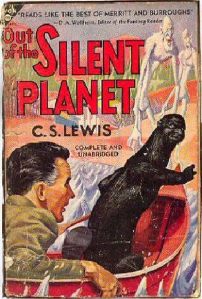
“One can see by looking at your eyes, Hman, that they are different from ours. But eldila are hard to see. They are not like us. Light goes through them. You must be looking in the right place and the right time; and that is not likely to come about unless the eldil wishes to be seen. Sometimes you can mistake them for a sunbeam or even a moving of the leaves; but when you look again you see that it was an eldil and that it is gone. But whether your eyes can ever see them I do not know. The séroni would know that.
ㅤ
ㅤ
ㅤ
p.80
Behind them arose, re-echoed from the remote rock pinnacles on either side of the valley, the bell-like, deep-mouthed voices of more than two hundred hrossa, more musical than a cry of hounds but closely akin to it in quality as in purport. Something long sleeping in the blood awoke in Ransom. It did not seem impossible at this moment that even he might be the hnakra-slayer; that the fame of Hman hnakrapunt might be handed down to posterity in this world that knew no other man. But he had had such dreams before, and knew how they ended. Imposing humility on the newly risen riot of his feelings, he turned his eyes to the troubled water of the current which they were skirting, without entering, and watched intently.
For a long time nothing happened. He became conscious of the stiffness of his attitude and deliberately relaxed his muscles. Presently Whin reluctantly went aft to paddle, and Hyoi came forward to take his place. Almost as soon as the change had been effected, Hyoi spoke softly to him and said, without taking his eyes off the current:
“There is an eldil coming to us over the water.”
Ransom could see nothing—or nothing that he could distinguish from imagination and the dance of sunlight on the lake. A moment later Hyoi spoke again, but not to him.
“What is it, sky-born?”
What happened next was the most uncanny experience Ransom had yet had on Malacandra. He heard the voice. It seemed to come out of the air, about a yard above his head, and it was almost an octave higher than the hross’s—higher even than his own. He realised that a very little difference in his ear would have made the eldil as inaudible to him as it was invisible.
“It is the man with you, Hyoi,” said the voice. “He ought not to be there. He ought to be going to Oyarsa. Bent hnau of his own kind from Thulcandra are following him; he should go to Oyarsa. If they find him anywhere else there will be evil.”
“He hears you, sky-born,” said Hyoi. “And have you no message for my wife? You know what she wishes to be told.”
“I have a message for Hleri,” said the eldil. “But you will not be able to take it. I go to her now myself. All that is well. Only—let the Man go to Oyarsa.”
There was a moment’s silence.
“He is gone,” said Whin. “And we have lost our share in the hunt.”
ㅤ
ㅤ
p.86
Meanwhile he felt remarkably well, though greatly chastened in mind. The silent, purple half-light of the woods spread all around him as it had spread on the first day he spent in Malacandra, but everything else was changed. He looked back on that time as on a nightmare, on his own mood at that time as a sort of sickness. Then all had been whimpering, unanalysed, self-nourishing, self-consuming dismay. Now, in the clear light of an accepted duty, he felt fear indeed, but with a sober sense of confidence in himself and in the world, and even an element of pleasure. It was the difference between a landsman in a sinking ship and a horseman on a bolting horse: either may be killed, but the horseman is an agent as well as a patient.
ㅤ
ㅤ
p.94
“Do you tell me, Small One, that there are no eldila in your world?”
“Not that I know of. But what are eldila, and why can I not see them? Have they no bodies?”
“Of course they have bodies. There are a great many bodies you cannot see. Every animal’s eyes see some things but not others. Do you know of many kinds of body in Thulcandra?”
Ransom tried to give the sorn some idea of the terrestrial terminology of solids, liquids and gases. It listened with great attention.
“That is not the way to say it,” it replied. “Body is movement. If it is at one speed, you smell something; if another, you hear a sound; if at another you see a sight; if at another, you neither see nor hear nor smell, nor know the body in any way. But mark this, Small One, that the two ends meet.”
“How do you mean?”
“If movement is faster, then that which moves is more nearly in two places at once.”
“That is true.”
“But if the movement were faster still—it is difficult, for you do not know many words—you see that if you made it faster and faster, in the end the moving thing would be in all places at once, Small One.”
“I think I see that.”
“Well, then, that is the thing at the top of all bodies—so fast that it is at rest, so truly body that it has ceased being body at all. But we will not talk of that. Start from where we are, Small One. The swiftest thing that touches our senses is light. We do not truly see light, we only see slower things lit by it, so that for us light is on the edge—the last thing we know before things become too swift for us. But the body of an eldil is a movement swift as light; you may say its body is made of light, but not of that which is light for the eldil. His “light” is a swifter movement which for us is nothing at all; and what we call light is for him a thing like water, a visible thing, a thing he can touch and bathe in—even a dark thing when not illuminated by the swifter. And what we call firm things—flesh and earth—seem to him thinner, and harder to see, than our light, and more like clouds, and nearly nothing. To us the eldil is a thin, half-real body that can go through walls and rocks: to himself he goes through them because he is solid and firm and they are like cloud. And what is true light to him and fills the heaven, so that he will plunge into the rays of the run to refresh himself from it, is to us the black nothing in the sky at night. These things are not strange, Small One, though they are beyond our senses. But it is strange that the eldila never visit Thulcandra.”
“Of that I am not certain,” said Ransom. It had dawned on him that the recurrent human tradition of bright, elusive people sometimes appearing on the Earth—albs, devas and the like—might after all have another explanation than the anthropologists had yet given. True, it would turn the universe rather oddly inside out; but his experiences in the space-ship had prepared him for some such operation.
“Why does Oyarsa send for me?” he asked.
“Oyarsa has not told me,” said the sorn. “But doubtless he would want to see any stranger from another handra.”
“We have no Oyarsa in my world,” said Ransom.
“That is another proof,” said the sorn, “that you come from Thulcandra, the silent planet.”
“What has that to do with it?”
The sorn seemed surprised. “It is not very likely if you had Oyarsa that he would never speak to ours.”
“Speak to yours? But how could he—it is millions of miles away.”
“Oyarsa would not think of it like that.”
“Do you mean that he ordinarily receives messages from other planets?”
“Once again, he would not say it that way. Oyarsa would not say that he lives on Malacandra and that another Oyarsa lives on another earth. For him Malacandra is only a place in the heavens; it is in the heavens that he and the others live. Of course they talk together. . . .”
ㅤ
ㅤ

ㅤ
p.97
Ransom awoke next morning with the vague feeling that a great weight had been taken off his mind. Then he remembered that he was the guest of a sorn and that the creature he had been avoiding ever since he landed had turned out to be as amicable as the hrossa, though he was far from feeling the same affection for it. Nothing then remained to be afraid of in Malacandra except Oyarsa . . . “The last fence,” thought Ransom.
Augray gave him food and drink.
“And now,” said Ransom, “how shall I find my way to Oyarsa?”
“I will carry you,” said the sorn. “You are too small a one to make the journey yourself and I will gladly go to Meldilorn. The hrossa should not have sent you this way. They do not seem to know from looking at an animal what sort of lungs it has and what it can do. It is just like a hross. If you died on the harandra they would have made a poem about the gallant hman and how the sky grew black and the cold stars shone and he journeyed on and journeyed on; and they would have put in a fine speech for you to say as you were dying . . . and all this would seem to them just as good as if they had used a little forethought and saved you life by sending you the easier way round.”
“I like the hrossa,” said Ransom a little stiffly. “And I think the way they talk about death is the right way.”
“They are right not to fear it, Ren-soom, but they do not seem to look at it reasonably as part of the very nature of our bodies—and therefore often avoidable at times when they would never see how to avoid it. For example, this has saved the life of many a hross, but a hross would not have thought of it.”
He showed Ransom a flask with a tube attached to it, and at the end of the tube a cup, obviously an apparatus for administering oxygen to oneself.
ㅤ
ㅤ
p.99
The shadow of the sorn, with Ransom’s shadow on its shoulder, moved over the uneven rock unnaturally distinct like the shadow of a tree before the headlights of a car; and the rock beyond the shadow hurt his eyes. The remote horizon seemed but an arm’s length away. The fissures and moulding of distant slopes were clear as the background of a primitive picture made before men learned perspective. He was on the very frontier of that heaven he had known in the space-ship, and rays that the air-enveloped worlds cannot taste were once more at work upon his body. He felt the old lift of the heart, the soaring solemnity, the sense, at once sober and ecstatic, of life and power offered in unasked and unmeasured abundance. If there had been air enough in his lungs he would have laughed aloud. And now, even in the immediate landscape, beauty was drawing near. Over the edge of the valley, as it had frothed down from the true harandra, came great curves of the rose-tinted, cumular stuff which he had seen so often from a distance. Now on a nearer view they appeared hard as stone in substance, but puffed above and stalked beneath like vegetation. His original simile of giant cauliflower turned out to be surprisingly correct—stone cauliflowers the size of cathedrals and the colour of pale rose. He asked the sorn what it was.
“It is the old forests of Malacandra,” said Augray. “Once there was air on the harandra and it was warm. To this day, if you could get up there and live, you would see it all covered with the bones of ancient creatures; it was once full of life and noise. It was then these forests grew, and in and out among their stalks went a people that have vanished from the world these many thousand years. They were covered not with fur but with a coat like mine. they did not go in the water swimming or on the ground walking; they glided in the air on broad flat limbs which kept them up. It is said they were great singers, and in those days the red forests echoed with their music. Now the forests have become stone and only eldila can go among them.”
“We still have such creatures in our world,” said Ransom. “We call them birds. Where was Oyarsa when all this happened to the harandra?”
“Where he is now.”
“And he could not prevent it?”
“I do not know. But a world is not made to last for ever, much less a race; that is not Maleldil’s way.”
As they proceeded the petrified forests grew more numerous, and often for half an hour at a time the whole horizon of the lifeless, almost airless, waste blushed like an English garden in summer. They passed many caves where, as Augray told him, sorns lived; sometimes a high cliff would be perforated with countless holes to the very top and unidentifiable noises came hollowly from within.
ㅤ
ㅤ
p.102
Often they drew out of him indirectly much more knowledge than the consciously possessed, apparently working from a wide background of general science. A casual remark about trees when Ransom was trying to explain the manufacture of paper would fill up for them a gap in his sketchy answered to their botanical questions; his account of terrestrial navigation might illuminate mineralogy; and his description of the steam-engine gave them a better knowledge of terrestrial air and water than Ransom had ever had. He had decided from the outset that he would be quite frank, for he now felt that it would be not hnau, and also that it would be unavailing, to do otherwise. They were astonished at what he had to tell them of human history—of war, slavery and prostitution.
“It is because they have no Oyarsa,” said one of the pupils.
“It is because every one of them wants to be a little Oyarsa himself,” said Augray.
“They cannot help it,” said the old sorn. “There must be rule, yet how can creatures rule themselves? Beasts must be ruled by hnau and hnau by eldila and eldila by Maleldil. These creatures have no eldila. They are like one trying to lift himself by his own hair—or one trying to see over a whole country when he is on a level with it—like a female trying to beget young on herself.”
Two things about our world particularly stuck in their minds. One was the extraordinary degree to which problems of lifting and carrying things absorbed our energy. The other was the fact that we had only one kind of hnau: they thought this must have far-reaching effects in the narrowing of sympathies and even of thought.
“Your thought must be at the mercy of your blood,” said the old sorn. “For you cannot compare it with thought that floats on a different blood.”
It was a tiring and very disagreeable conversation for Ransom. But when at last he lay down to sleep it was not of the human nakedness nor of his own ignorance that he was thinking. He thought only of the old forests of Malacandra and of what it might mean to grow up seeing always so few miles away a land of colour that could never be reached and had once been inhabited.
ㅤ
ㅤ

ㅤ
p.130
To every man, in his acquaintance with a new art, there comes a moment when that which before was meaningless first lifts, as it were, one corner of the curtain that hides its mystery, and reveals, in a burst of delight which later and fuller understanding can hardly ever equal, one glimpse of the indefinite possibilities within. For Ransom, this moment had now come in his understanding of Malacandrian song. Now first he saw that its rhythms were based on a different blood from ours, on a heart that beat more quickly, and a fiercer internal heat, Through his knowledge of the creatures and his love for them he began, ever so little, to hear it with their ears. A sense of great masses moving at visionary speeds, of giants dancing, of eternal sorrows eternally consoled, of he knew not what and yet what he had always known, awoke in him with the very first bars of the deep-mouthed dirge, and bowed down his spirit as if the gate of heaven had opened before him.
“Let it go hence,” they sang. “Let it go hence, dissolve and be nobody. Drop it, release it, drop it gently, as a stone is loosed from the fingers drooping over a still pool. Let it go down, sink, fall away. Once below the surface there are no divisions, no layers in the water yielding all the way down; all one and all unwounded is that element. Send it voyaging where it will not come again. Let it go down; the hnau rises from it. This is the second life, the other beginning. Open, oh coloured world, without weight, without shore. You are second and better; this was first and feeble. Once the worlds were hot within and brought froth life, but only the pale plants, the dark plants. We see their children when they grow to-day, out of the sun’s light in the sad places. After, the heaven made grow another kind on worlds: the high climbers, the bright-haired forests, cheeks of flowers. First were the darker, then the brighter. First was the worlds’ blood, then the suns’ blood.”
ㅤ
ㅤ
p.132
The guards fell away on each side. Weston’s usually pale face, under the bracing influence of the cold water, had assumed the colour of a ripe tomato, and his hair, which had naturally not been cut since he reached Malacandra, was plastered in straight lank masses across his forehead. A good deal of water was still dripping over his nose and ears. His expression—unfortunately wasted on an audience ignorant of terrestrial physiognomy—was that of a brave man suffering in a great cause, and rather eager than reluctant to face the worst of even to provoke it. In explanation of his conduct it is only fair to remember that he had already that morning endured all the terrors of an expected martyrdom and all the anticlimax of fourteen compulsory cold douches. Devine, who knew his man, shouted out to Weston in English:
“Stead, Weston. These devils can split the atom or something pretty like it. Be careful what you say to them and don’t let’s have any of your bloody nonsense.”
ㅤ
ㅤ
p.134
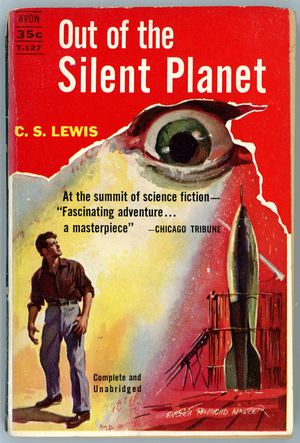
“To you I may seem a vulgar robber, but I bear on my shoulders the destiny of the human race. Your tribal life with its stone-age weapons and bee-hive huts, its primitive coracles and elementary social structure, has nothing to compare with our civilization—with our science, medicine and law, our armies, our architecture, our commerce, and our transport system which is rapidly annihilating space and time. Our right to supersede you is the right of the higher over the lower. Life——”
“Half a moment,” said Ransom in English. “That’s about as much as I can manage at one go.” Then, turning to Oyarsa, he began translate as well as he could. The process was difficult and the result—which he felt to be rather unsatisfactory—was something like this:
“Among us, Oyarsa, there is a kind of hnau who will take other hnau’s food and—and things, when they are not looking. He says he is not an ordinary one of that kind. He says what he does now will make very different things happen to those of our people who are not yet born. He says that, among you, hnau of one kindred all live together and the hrossa have spears like those we used a very long time ago and your huts are small and round and your boats small and light and like our old ones, and you have only one ruler. He says it is different with us. He says we know much. There is a thing happens in our world when the body of a living creature feels pains and becomes weak, and he says we sometimes know how to stop it. He says we have many bent people and we kill them or shut them in huts and that we have people for settling quarrels between the bent hnau about their huts and mates and things. He says we have many ways for the hnau of one land to kill those of another and some are trained to do it. He says we build very big and strong huts of stones and other things—like the pfifltriggi. And he says we exchange many things among ourselves and can carry heavy weights very quickly and a long way. Because of all this, he says it would not be the act of a bent hnau if our people killed all your people.”
As soon as Ransom finished, Weston continued.
“Life is greater than any system of morality; her claims are absolute. It is not by tribal taboos and copy-book maxims that she has pursued her relentless march from the amoeba to man and from man to civilization.”
ㅤ
ㅤ
ㅤ
p.135
“She——” began Weston.
“I’m sorry,” interrupted Ransom, “but I’ve forgotten who She is.”
“Life, of course,” snapped Weston. “She has ruthlessly broken down all obstacles and liquidated all failures and to-day in her highest form—civilized man—and in me as his representative, she presses forward to that interplanetary leap which will, perhaps, place her for ever beyond the reach of death.”
“He says,” resumed Ransom, “that these animals learned to do many difficult things, except those who could not; and those ones died and the other animals did not pity them. And he says the best animal now is the kind of man who makes the big huts and carries the heavy weights and does all the other things I told you about; and he is one of these and he says that if the others all knew what he was doing they would be pleased. He says that if he could kill you all and bring our people to live in Malacandra, then they might be able to go on living here after something had gone wrong with our world. And then if something went wrong with Malacandra they might go and kill all the hnau in another world. And then another—and so they would never die out.”
“It is in her right,” said Weston, “the right, or, if you will, the might of Life herself, that I am prepared without flinching to plant the flag of man on the soil of Malacandra: to march on, step by step, superseding, where necessary, the lower forms of life that we find, claiming planet after planet, system after system, till our posterity—whatever strange form and yet unguessed mentality they have assumed—dwell in the universe wherever the universe is habitable.”
“He says,” translated Ransom, “that because of this it would not be a bent action—or else, he says, it would be a possible action—for him to kill you all and bring us here. He says he would feel no pity. He is saying again that perhaps they would be able to keep moving from one world to another and wherever they came they would kill everyone. I think he is now talking about worlds that go round other suns. He wants the creatures born from us to be in as many places as they can. He says he does not know what kind of creatures they will be.”
“I may fall,” said Weston. “But while I live I will not, with such a key in my hand, consent to close the gates of the future on my race. What lies in that future, beyond our present ken, passes imagination to conceive: it is enough for me that there is a Beyond.”
“He is saying,” Ransom translated, “that he will not stop trying to do all this unless you kill him. And he says that though he doesn’t know what will happen to the creatures sprung from us, he wants it to happen very much.”
Weston, who had now finished his statement, looked round instinctively for a chair to sink into. On Earth he usually sank into a chair as the applause began. Finding none—he was not the kind of man to sit on the ground like Devine—he folded his arm and stared with a certain dignity about him.
“it is well that I have heard you,” said Oyarsa. “For though your mind is feebler, your will is less bent than I thought. It is not for yourself that you would do all this.”
“No,” said Weston proudly in Malacandrian. “Me die. Man live.”
“Yet you know that these creatures would have to be made quite unlike you before they lived on other worlds.”
“Yes, yes. All new. No one know yet. Strange! Big!”
“Then it is not the shape of body that you love?”
“No. Me no care how they shaped.”
“One would think, then, that it is for the mind you care. But that cannot be, or you would love hnau wherever you met it.”
“No care for hnau. Care for man.”
“But if it is neither man’s mind, which is as the mind of all other hnau—is not Maleldil maker of them all?—nor his body, which will change—if you care for neither of these, what do you mean by man?”
This had to be translated to Weston. When he understood it, he relied:
“Me care for men—care for our race—what man begets—” he had to ask Ransom the worlds for race and beget.
“Strange!” said Oyarsa. “You do not love any one of your race—you would have let me kill Ransom. You do not love the mind of your race, nor the body. Any kind of creature will please you if only it is begotten by your kind as they now are. It seems to me, Thick One, that what you really love is no completed creature but the very seed itself: for that is all that is left.”
“Tell him,” said Weston when he had been made to understand this, “that I don’t pretend to be a metaphysician. I have not come here to chop logic. If he cannot understand—as apparently you can’t either—anything so fundamental as a man’s loyalty to humanity, I can’t make him understand it.”
But Ransom was unable to translate this and the voice of Oyarsa continued.
“I see now how the lord of the silent world has bent you. There are laws that all hnau know, of pity and straight dealing and shame and the like, and one of these is the love of kindred. He has taught you to break all of them except this one, which is not one of the greatest laws; this one he has bent till it becomes folly and has set it up, thus bent, to be a little, blind Oyarsa in your brain. And now you can do nothing but obey it, thought if we ask you why it is a law you give no other reason for it than for all the other and greater laws which it drives you to disobey. Do you know why he has done this?”
“Me think no such person—me wise, new man—no believe all that old talk.”
“I will tell you. He has left you this one because a bent hnau can do more evil than a broken one. He has only bent you; but this Thin One who sits on the ground he has broken, for he has left him nothing but greed. He is now only a talking animal and in my world he could do no more evil than an animal. If he were mine I would unmake his body for the hnau in it is already dead. But if you were mine I would try to cure you. Tell me, Thick One, why did you come here?”
“Me tell you. Make man live all the time.”
“But are your wise men so ignorant as not to know that Malacandra is older than your own world and nearer its death? Most of it is dead already. My people live only in the handramits; the heat and the water have been more and will be less. Soon now, very soon, I will end my world and give back my people to Maleldil.”
“Me know all that plenty. This only first try. Soon they go on another world.”
“But do you not know that all worlds will die?”
“Men go jump off each before it deads—on and on, see?”
“And when all are dead?”
Weston was silent. After a time Oyarsa spoke again.
“Do you not ask why my people, whose world is old, have not rather come to yours and taken it long ago?”
“Ho! Ho!” said Weston. “You not know how.”
“You are wrong,” said Oyarsa. “Many thousands of thousand years before this, when nothing yet lived on your world, the cold death was coming on my harandra. Then I was in deep trouble, not chiefly for the death of my hnau—Meledil does not make them long-livers—but for the things which the lord of your world, who was not yet bound, put into their minds. He would have made them as your people are now—wise enough to see the death of their kind approaching but not wise enough to endure it. Bent counsels would soon have risen among them. They were well able to have made sky-ships. By me Maleldil stopped them. Some I cured, some I unbodied——”
“And see what come!” interrupted Weston. “You now very few—shut up in handramits—soon all die.”
“Yes,” said Oyarsa, “but one thing we left behind us on the harandra: fear. And with fear, murder and rebellion. The weakest of my people do not fear death. It is the Bent One, the lord of your world, who wastes your lives and befouls them with flying from what you know will overtake you in the end. If you were subjects of Maleldil you would have peace.”
Weston writhed in the exasperation born of his desire to speak and his ignorance of the language.
“Trash! Defeatist trash!” he shouted at Oyarsa in English; then, drawing himself up to his full height, he added in Malacandrian, “You say your Maleldil let all go dead. Other one, Bent One, he fight, jump, live—not all talkee-talkee. Me no care Maleldil. Like Bent One better: me on his side.”
“But do you not see that he never will nor can,” began Oyarsa, and then broke off, as if recollecting himself. “But I must learn more of your world from Ransom, and for that I need till night. I will not kill you, not even the Thin One, for you are out of my world. To-morrow you shall go hence again in your ship.”
ㅤ
ㅤ

ㅤ
p.140
But they will do something else to your ship. I am not minded that it should return into the heaven if once it reaches Thulcandra. You, Thick One, were not here when I unmade my dead hrossa whom you killed: the Thin One will tell you. This I can do, as Maleldil has taught me, over a gap of time or a gap of place. Before your sky-ship rises, my sorns will have so dealth with it that one the ninetieth day it will unbody, it will become what you call nothing. If that day finds it in heaven your death will be no bitterer because of this; but do not tarry in your ship if once you touch Thulcandra. Now lead these two away, and do you, my children, go where you will. But I must talk with Ransom.”
ㅤ
ㅤ
p.145
He soon fell back into his old routine of sleeping and basking, punctuated with the making of some scribbled notes for his Malacandrian dictionary. He knew that there was very little chance of his being able to communicate his new knowledge to man, that unrecorded death in the depth of space would almost certainly be the end of their adventure. But already it had become impossible to think of it as “space.” Some moments of cold fear he had; but each time they were shorter and more quickly swallowed up in a sense of awe which made his personal fate seem wholly insignificant. He could not feel that they were an island of life journeying through an abyss of death. He felt almost the opposite—that life was waiting outside the little iron egg-shell in which they rode, ready at any moment to break in, and that, if it killed them, it would kill them by excess of its vitality. He hoped passionately that if they were to perish they would perish by the “unbodying” of the space-ship and not by suffocation within it. To be let out, to be free, to dissolve into the ocean of eternal noon, seemed to him at certain moments a consummation even more desirable than their return to Earth. And if he had felt some such lift of the heart when first he passed through heaven on their outward journey, he felt it now tenfold, for now he was convinced that the abyss was full of life in the most literal sense, full of living creatures.
His confidence in Oyarsa’s words about the eldila increased rather than diminished as they went on. He saw none of them; the intensity of light in which the ship swam allowed none of the fugitive variations which would have betrayed their presence. But he heard, or thought he heard, all kinds of delicate sound, or vibrations akin to sound, mixed with the tinkling rain of meteorites, and often the sense of unseen presences even within the space-ship became irresistible. It was this, more than anything else, that made his own chances of life seem so unimportant. He and all his race showed small and ephemeral against a background of such immeasurable fullness. His brain reeled at the thought of the true population of the universe, the three-dimensional infinitude of their territory, and the unchronicled æons of their past; but his heart became steadier than it had ever been.
ㅤ
ㅤ
p.150
At this point, If I were guided by purely literary considerations, my story would end, but it is time to remove the mask and to acquaint the reader with the real and practical purpose for which this book has been written. At the same time he will learn how the writing of it became possible at all.
Dr. Ransom—and at this stage it will become obvious that that is not his real name—soon abandoned the idea of his Malacandrian dictionary and indeed all idea of communicating his story to the world. He was ill for several months, and when he recovered be found himself in considerable doubt as to whether what he remembered had really occurred. It looked very like a delusion produced by his illness, and most of his apparent adventures could, he saw, be explained psychoanalytically. He did not lean very heavily on this fact himself, for he had long since observed that a good many “real” things in the fauna and flora of our own world could be accounted for in the same way if you started with the assumption that they were illusions. But he felt that if he himself half doubted his own story the rest of the world would disbelieve it completely. He decided to hold his tongue, and there the matter would have rested but for a very curious coincidence.
This is where I come into the story. I had known Dr. Ransom slightly for several years and corresponded with him on literary and philological subjects, though we very seldom met. It was, therefore, quite in the usual order of things that I should write him a letter some months ago, of which I will quote the relevant paragraph. It ran like this:
“I am now working at the Platonists of the twelfth century and incidentally discovering that they wrote damnably difficult Latin. In one of them, Bernardus Silvestris, there is a word I should particularly like your views on—the word Oyarses. It occurs in the description of a voyage through the heavens, and an Oyarses seems to be the ‘intelligence” or tutelary spirit of a heavenly sphere, i. e. in our language, of a planet. I asked C. J. about it and he says it ought to be Ousiarches. That, of course, would make sense, but I do not feel quite satisfied. Have you by any chance ever come across a word like Oyarses, and can you hazard any guess as to what language it may be?”
The immediate result of this letter was an invitation to spend a weekend with Dr. Ransom. He told me his whole story, and since then he and I have been almost continuously at work on the mystery. A good many facts, which I have no intention of publishing at present, have fallen into our hands; facts about planets in general and about Mars in particular, facts about mediæval Platonists, and (not least in importance) facts about the Professor to whom I am giving the fictitious name of Weston. A systematic report of these facts might, of course, be given to the civilized world: but that would almost certainly result in universal incredulity and in a libel action from “Weston.” At the same time, we both feel that we cannot be silent. We are being daily confirmed in our belief that the oyarses of Mars was right when it said that the present “celestial year” was to be a revolutionary one, that the long isolation of our own planet is nearing its end, and that great doings are on foot. We have found reason to believe that the mediæval Platonists were living in the same celestial year as ourselves—in fact, that it began in the twelfth century of our era—and that the occurrence of the name Oyarsa (Latinized as oyarses) in Bernardus Silvestris is not an accident. And we have also evidence—increasing almost daily—that “Weston,” or the force or forces behind “Weston,” will play a very important part in the events of the next few centuries, and, unless we prevent them, a very disastrous one. We do not mean that they are likely to invade Mars—our cry is not merely “Hands off Malacandra.” The dangers to be feared are not planetary but cosmic, or at least solar, and they are not temporal but eternal. More than this it would be unwise to say.
It was Dr. Ransom who first saw that our only chance was to publish in the form of fiction what would certainly not be listened to as fact. He even thought—greatly overrating my literary powers—that this might have the incidental advantage of reaching a wider public, and that, certainly, it would reach a great many people sooner than “Weston.” To my objection that if accepted as fiction it would for that very reason be regarded as false, he replied that there would be indications enough in the narrative for the few readers—the very few—who at present were prepared to go further into the matter.
“And they,” he said, “will easily find out you, or me, and will easily identify Weston. Anyway,” he continued, “what we need for the moment is not so much a body of belief as a body of people familiarized with certain ideas. If we could even effect in one per cent of our readers a change-over from the conception of Space to the conception of Heaven, we should have made a beginning.”
What neither of us foresaw was the rapid march of events which was to render the book out of date before it was published. These events have already made it rather a prologue to our story than the story itself. But we must let it go as it stands. For the later stages of the adventure—well, it was Aristotle, long before Kipling, who taught us the formula, “That is another story.”
ㅤ
POSTSCRIPT
(Being extracts from a letter written by the original “Dr. Ransom” to the author.)
ㅤ
p.156
Why must you leave out my account of how the shutter jammed just before our landing on Malacandra? Without this, your description of our sufferings from excessive light on the return journey raises the very obvious question, “Why didn’t they close their shutters?” I don’t believe your theory that “readers never notice that sort of thing.” I’m sure I should.
There are two scenes that I wish you could have worked into the book; no matter—they are worked into me. One or other of them is always before me when I close my eyes.
In one of them I see the Malacandrian sky at morning; pale blue, so pale that now, when I have grown once more accustomed to terrestrial skies, I think of it as almost white. Against it the nearer tops of the giant weeds—the “trees” as you call them—show black, but far away, across miles of that blinding blue water, the remoter woods are water-colour purple. The shadows all around me on the pale forest floor are like shadows on snow. There are figures walking before me; slender yet gigantic forms, black and sleek as animated tall hats; their huge round heads, poised on their sinuous stalk-like bodies, give them the appearance of black tulips. They go down, singing, to the edge of the lake. The music fills the wood with its vibration, though it is so soft that I can hardly hear it: it is like dim organ music. Some of them embark, but most remain. It is done slowly; this is no ordinary embarkation, but some ceremony. It is, in fact, a hross funeral. Those three with the grey muzzles whom they have helped into the boat are going to Meldilorn to die. For in that world, except for some few whom the hnakra gets, no one dies before his time. All live out the full span allotted to their kind, and a death with them is as predictable as a birth with us. The whole village has known that those three will die this year, this month; it was an easy guess that they would die even this week. And now they are off, to receive the last counsel of Oyarsa, to die, and to be by him “unbodied.” The corpses, as corpses, will exist only for a few minutes: there are no coffins in Malacandra, no sextons, churchyards, or undertakers. The valley is solemn at their departure, but I see no signs of passionate grief. They do not doubt their immortality, and friends of the same generation are not torn apart. You leave the world, as you entered it, with the “men of your own year.” Death is not preceded by dread nor followed by corruption.
The other scene is nocturne. I see myself bathing with Hyoi in the warm lake. He laughs at my clumsy swimming; accustomed to a heavier world, I can hardly get enough of me under the water to make any headway. And then I see the night sky. The greater part of it is very like ours, though the depths are blacker and the stars brighter; but something that no terrestrial analogy will enable you fully to picture is happening in the west. Imagine the Milky Way magnified—the Milky Way seen through our largest telescope on the clearest night. And then imagine this, not painted across the zenith, but rising like a constellation behind the mountain-tops—a dazzling necklace of lights brilliant as planets, slowly heaving itself up till it fills a fifth of the sky and now leaves a belt of blackness between itself and the horizon. It is too bright to look at for long, but it is only a preparation. Something else is coming. There is a glow like moonrise on the harandra. Ahihra! cries Hyoi, and other baying voices answer him from the darkness all about us. And now the true king of night is set up, and now he is threading his way through that strange western galaxy and making its lights dim by comparison with his own. I turn my eyes away, for the little disk is far brighter than the Moon in her greatest splendour. The whole handramit is bathed in colourless light; I could count the stems of the forest on the far side of the lake; I see that my fingernails are broken and dirty. And now I guess what it is that I have seen—Jupiter rising beyond the Asteroids and forty million miles nearer than he has ever been to earthly eyes. But the Malacandrians would say “within the Asteroids,” for they have an odd habit, sometimes, of turning the solar system inside out. They call the Asteroids the “dancers before the threshold of the Great Worlds.” The Great Worlds are the planets, as we should say, “beyond” or “outside” the Asteroids. Glundandra (Jupiter) is the greatest of these and has some importance in Malacandrian thought which I cannot fathom. He is “the centre,” “great Meldilorn,” “throne” and “feast.” They are, of course, well aware that he is uninhabitable, at least by animals of the planetary type; and they certainly have no pagan idea of giving a local habitation to Maleldil. But somebody or something of great importance is connected with Jupiter; as usual “The séroni would know.” But they never told me. Perhaps the best comment is in the author whom I mentioned to you: “For as it was well said of the great Africanus that he was never less alone than when alone, so, in our philosophy, no parts of this universal frame are less to be called solitaire than those which the vulgar esteem most solitaire, since the withdrawing of men and beasts signifieth but the greater frequency of more excellent creatures.”
More of this when you come. I am trying to read every old book on the subject that I can hear of. Now that “Weston” has shut the door, the way to the planets lies through the past; if there is to be any more space-travelling, it will have to be time-travelling as well . . . !
 Universe of Dahee